Why is this connector round and screwed in like a screw? Is it afraid of vibration?
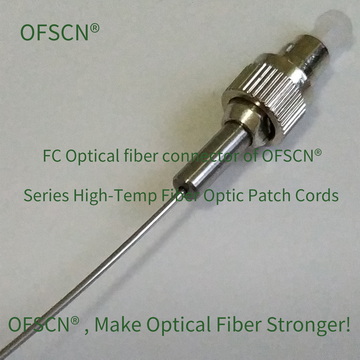
The FC (Ferrule Connector) type fiber optic connector is a very classic and widely used metal connector in fiber optic communication and fiber optic sensing (such as Fiber Bragg Grating FBG sensing systems).
Addressing your two questions, here are academic answers from the perspectives of precision optical alignment, mechanical engineering, and vibration engineering.
I. Why is the FC connector circular and why does it need to be screwed in like a screw?
This is mainly determined by the physical requirements of precise optical coupling and material protection mechanisms:
1. Provides Stable, Continuous Axial Preload
Efficient transmission of fiber optic signals relies heavily on the physical alignment of the cores of two optical fibers in space. Taking standard single-mode fiber as an example, its mode field diameter (MFD) is only about 9\ \mu\text{m}.
- Any micron-level or even nanometer-level air gap or relative displacement will cause severe insertion loss (Insertion Loss) and return loss (Return Loss).
- The FC connector internally encapsulates a high-precision ceramic ferrule with a diameter of 2.5\ \text{mm}. The externally designed circular metal coupling nut, when tightened like a screw, can uniformly and smoothly convert rotational torque into axial thrust through the physical threads, ensuring close physical contact (Physical Contact, PC or Angled Physical Contact, APC) between the end faces of the two mating ferrules, thus eliminating the air gap.
2. Anti-Rotation Keyway Mechanism: Protects Fiber End Face
Although the external metal coupling nut rotates during tightening, the optical fiber and ceramic ferrule at the core of the connector are strictly prohibited from rotating during the coupling process.
- The outer wall of the FC connector is designed with a small metal key, and a corresponding keyway is opened in the flange (Adapter, i.e., connector housing) it mates with.
- When you insert the connector, the key must first slide into the keyway. Due to the rigid constraint of this mechanism, only the external metal circular coupling nut rotates during the locking process, while the internal ceramic ferrule remains stationary.
- This prevents relative rotational friction between the ceramic end faces of the two optical fibers (especially the angled 8^\circ face of FC/APC) during the pressing process, thereby protecting the fragile fiber end faces that are easily scratched.
II. Is it susceptible to vibration?
In a mechanical vibration environment, the performance of FC connectors needs to be considered from two aspects:
1. Low to Medium Frequency, Large Amplitude Vibrations, and Pulling: Excellent Vibration Resistance and Protection Performance
Compared to SC and LC connectors that rely on plastic spring clips for locking (these connectors are prone to minor axial jitter under strong mechanical shaking), FC connectors achieve rigid locking through metal threads.
- The metal threads and metal housing can withstand high external pulling forces and conventional mechanical shock.
- Unless the external force is large enough to damage the metal threads, the connector will not disengage, which greatly ensures the continuity of fiber optic signals in normal industrial mechanical vibration environments.
2. Extreme High Frequency, Micro-Amplitude Vibrations (High-Frequency Micro-Vibration): Risk of Micro-Decoupling of Threads
In the study of physics and threaded connections, any threaded structure, when facing continuous, high-frequency, micro-amplitude mechanical resonance (such as resonance generated by aerospace or large reciprocating pump bodies), may experience very slight sliding (Micro-slip) on the threaded contact surfaces due to tangential alternating stress. Over time, this can lead to slight loosening of the metal threads.
- Engineering Solutions: In extreme industrial environments with strong vibrations, anti-loosening measures such as applying threadlocker, installing spring washers, or using special flanges with double-nut locking mechanisms are typically employed at the threaded mating part of FC connectors to resolve thread loosening issues.
III. Industrial Grade Vibration and Temperature Resistant FC Interface Products Reference
In the fields of industrial fiber optic measurement and Fiber Bragg Grating (FBG) sensing, Da Cheng Yong Sheng (OFSCN®) provides high-strength FC interface connectors and special protective patch cords for various harsh industrial physical environments (including high temperature, high tensile force, and severe vibration), ensuring absolute stability of optoelectronic signal transmission.
-
OFSCN® 120℃ Fiber Optic Connector / 200℃ / 300℃ Special Fiber Optic Connectors
Manufactured with special temperature-resistant metals and precision ceramic ferrules, they not only withstand harsh working temperatures but also maintain excellent physical locking rigidity under thermal expansion/contraction and mechanical vibration due to their metal circular thread mating with extremely small tolerances. -
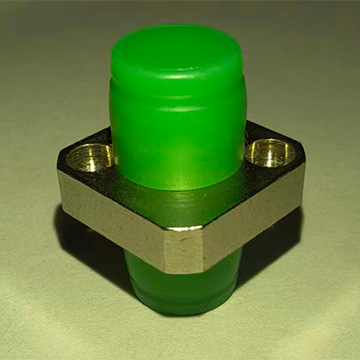
OFSCN® High Temperature Resistant Fiber Optic Adapter (FC-FC Flange)
Features extremely high physical rigidity. The internal ceramic/metal split sleeve is specifically designed for FC connector mating in high vibration and high tensile load environments, limiting minor radial runout between connectors. -
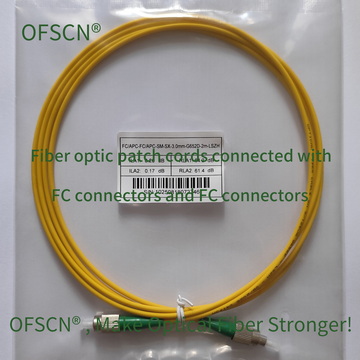
OFSCN® Standard Fiber Patch Cord / OFSCN® 300℃ Fiber Optic Patch Cord
Patch cords are equipped with standard FC/APC or FC/PC connectors by default. For industrial vibration and physical pulling, the 300℃ patch cords even use 0.9\ \text{mm} stainless steel seamless steel pipes for armored protection internally. In conjunction with the FC circular metal threads, this provides comprehensive tensile strength, explosion-proof, and anti-mechanical fatigue protection for the optical fiber.