If you overtighten an FC connector, will you crack the ceramic ferrule?
Under normal operating conditions, manually tightening an FC connector will absolutely not shatter the ceramic ferrule; however, if excessive torque is applied using tools such as wrenches, or if brute force is applied when the keyway is misaligned, it may lead to chipping of the ceramic ferrule or cracking within the adapter.
Analysis based on mechanical structural principles and force physics mechanisms is as follows:
I. Why Manual Tightening Won’t Cause Shattering?
-
Floating Ferrule and Spring-Loaded Design
FC connectors (FC/PC, FC/APC) utilize a floating ferrule structure internally. The commonly used 2.5\ \text{mm} outer diameter ceramic ferrule (high-purity zirconium dioxide, \text{ZrO}_2) is not rigidly fixed to the threaded sleeve base but is equipped with a spring at the rear for elastic compensation.- When the threaded sleeve is screwed into the flange (adapter), after the end faces of the ferrules on both ends come into contact, any excess insertion displacement is absorbed by the internal spring.
- The actual axial contact pressure between the end faces is entirely determined by the elastic coefficient and compression stroke of the internal spring. The standard pre-tightening force is typically constant, ranging between 8\ \text{N} \sim 12\ \text{N}.
-
External Threaded Sleeve Mechanically Limits and Distributes Load
The axial mechanical tensile force generated by rotating the external metal nut is ultimately borne by the steps of the connector’s metal housing and the stop of the adapter’s metal end face, preventing it from being infinitely superimposed onto the ferrule’s end face. -
Recommended Tightening Torque and Hand-Tightening Force
In industrial fiber optic connection standards, the recommended tightening torque for FC connectors is generally between 0.2\ \text{N}\cdot\text{m} \sim 0.4\ \text{N}\cdot\text{m}. The torque that can be applied by human fingers directly gripping and rotating the threaded sleeve (Finger-tight) is approximately 0.2\ \text{N}\cdot\text{m} \ \sim 0.3\ \text{N}\cdot\text{m}. Once the resistance limit is reached, fingers cannot apply more torque. This range falls entirely within the elastic safety margin of the structural design.
II. Under What Circumstances Can Ferrule Damage Occur?
Although normal manual tightening will not cause the ferrule to shatter, permanent mechanical damage to the ferrule and adapter is highly likely under the following non-standard operations or extreme conditions:
- Forced Rotation When Keyway is Misaligned
FC connectors feature a keyway for anti-rotation and orientation. If the key does not smoothly slide into the slot when inserting into the adapter, and the thread is forcibly tightened while the key is outside the slot, the ferrule will be subjected to oblique radial shear forces and non-coaxial axial forces. This can easily cause chipping at the edge of the ceramic ferrule’s end face, and the keyway itself may be directly sheared off. For FC/APC connectors with an angled physical contact (APC) end face (8^\circ), the risk of damage from misaligned forceful tightening is even higher. - Over-tightening Using Tools
If tools such as adjustable wrenches or pipe wrenches are used to apply torque far exceeding 0.5\ \text{N}\cdot\text{m}, it may lead to deformation of the metal threads (stripping) or even cause the precision ceramic split sleeve inside the adapter to experience excessive local bending or compressive stress, resulting in longitudinal cracking. - Stress Concentration Due to Foreign Particles
If the ferrule end face is not cleaned before mating, and contaminants like quartz dust or metal particles (at micron scale) with extremely high Mohs hardness adhere to it, the local compressive stress at the contact point of the particles can reach tens of gigapascals (\text{GPa}) under the axial pressure applied by the spring. This can directly cause severe pitting and microcracking on the fiber core or ceramic end face.
III. Related Products
In Beijing Dacheng Yongsheng Technology Co., Ltd.'s (OFSCN®) Fiber Bragg Grating (FBG) sensor and high-temperature fiber optic jumper series, FC connectors are the standard interface configuration. For high-temperature applications, specialized temperature-resistant connection structures have also been designed:
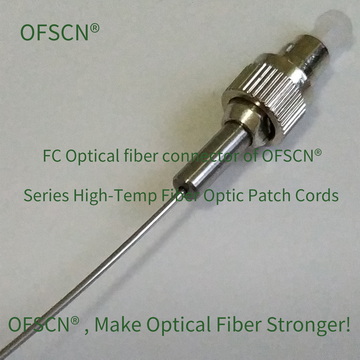
These connectors employ high-temperature resistant metal structures and precision ceramic ferrules. They maintain strict mechanical dimensional stability and elastic resilience even in harsh ambient temperatures ranging from -20\ ^\circ\text{C} to 120\ ^\circ\text{C}. To ensure reliable connections, operations should follow the principle of “align the keyway, finger-tighten until it stops.” Blindly applying force with mechanical tools is strictly prohibited.