Why do fiber optic patch cords have an advantage over electrical cables in strong magnetic field environments?
In strong magnetic and high electromagnetic interference (EMI) environments, fiber optic patch cords exhibit decisive physical advantages over traditional copper cables. This superiority stems primarily from the fundamental differences in material physics properties and signal transmission mechanisms:
1. Fundamental Distinction Between Insulating Medium and Conductive Metal
- Physical Deficiencies of Cables: Copper or aluminum cables use electrical conductors to transmit electrical signals. According to Faraday’s law of electromagnetic induction, in strong alternating magnetic fields (or when conductors move relative to a constant magnetic field), induced electromotive force and induced currents (eddy currents) are generated within the cables. This leads to:
- Severe noise interference and signal distortion;
- Ground loop currents;
- Additional heating or safety hazards in high-energy, strong magnetic field environments.
- Insulating Advantage of Fiber Optic Patch Cords: The core and cladding of optical fibers are primarily composed of high-purity silica glass (\text{SiO}_2), which is an electrical insulator and an isotropic medium with a relative magnetic permeability \mu_r \approx 1. Strong magnetic fields cannot induce electron flow or microscopic currents in the non-conductive quartz medium, thus fiber optic patch cords are naturally immune to strong magnetic fields and electromagnetic interference.
2. Anti-Interference Mechanism of Transmission Medium
- Cables rely on the drift of electrons in metal for signal transmission, making them extremely sensitive to external electromagnetic field variations.
- Fiber optic patch cords transmit high-frequency light waves (e.g., near-infrared light with a wavelength of \lambda = 1550\text{nm}, at frequencies on the order of 10^{14}\text{Hz}) through the principle of total internal reflection. Conventional or high-intensity industrial magnetic fields have virtually no impact on the propagation path, wavelength, or light intensity of the photon stream, enabling high-fidelity signal transmission with no attenuation or distortion.
3. High-Frequency Impedance and Skin Effect
- Under high-frequency alternating magnetic fields, cables exhibit significant skin effect and proximity effect, reducing the effective cross-sectional area of the conductor and drastically increasing equivalent impedance, leading to severe signal attenuation.
- Fiber optic patch cords transmit optical signals without relying on electron conductors and are completely unaffected by the skin effect or impedance changes, thus maintaining ultra-high bandwidth and ultra-low loss at all times.
4. System Safety and Electrical Isolation
In scenarios with strong magnetic fields or high voltages, such as Nuclear Magnetic Resonance (MRI), high-voltage substations, variable frequency drive systems, and high-energy physics laboratories, the use of fiber optic patch cords provides optoelectronic isolation, completely eliminating the risks of high-voltage breakdown and electrical sparks, thereby ensuring the safety of equipment and personnel.
Related Technical Product Support
In environments with strong electromagnetic interference and complex electrical conditions, OFSCN® provides a variety of highly reliable fiber optic patch cord products for communication and fiber optic sensing signal transmission.
For example, standard all-dielectric structured patch cords:
OFSCN® Standard Fiber Patch Cord
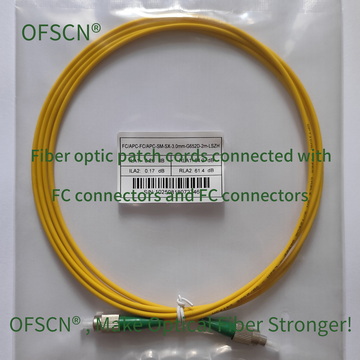
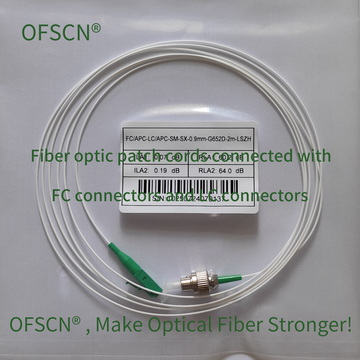
For magnetic field environments requiring higher mechanical tensile and compressive strength, armored patch cord products with high protection levels can also be selected. The specific structural choice needs to be evaluated based on whether complete metal-free requirements are present on-site.