Why can fiber optic patch cords be routed close to high-voltage cables without interference?
The reason fiber optic patch cords can be routed directly alongside high-voltage cables without interference is their perfect “electromagnetic transparency” at the physical layer. This is primarily determined by the signal transmission mechanism of optical fibers and the dielectric properties of their base materials.
I. Core Physical Principle: Why No Electromagnetic Interference?
-
Fundamental Difference in Signal Carriers (Photons vs. Electrons)
Traditional metal wires (like copper wires) transmit signals using the flow of electric charge (electrons), which is highly susceptible to electromagnetic coupling interference (EMI/RFI) from external electric and magnetic fields.
Fiber optic patch cords transmit high-frequency photons (light waves). Light waves belong to a very high-frequency part of the electromagnetic spectrum, with operating wavelengths (typically 1310\text{ nm} or 1550\text{ nm}) corresponding to frequencies in the terahertz (\text{THz}) range. This differs by more than ten orders of magnitude from the alternating electromagnetic fields generated by high-voltage cables (typically the power frequency of 50\text{ Hz} or 60\text{ Hz} and its low-frequency harmonics). The macroscopic alternating electromagnetic fields produced by high-voltage cables cannot modulate or alter the phase, amplitude, or wavelength of the high-frequency photons in the optical fiber. Therefore, optical signals possess inherent electromagnetic immunity during transmission. -
Dielectric Properties of Base Material (High-Purity Silicon Dioxide)
The core and cladding of optical fibers are mainly composed of high-purity silicon dioxide (\text{SiO}_2) glass. Silicon dioxide is an excellent electrical insulator:- No Free Charges: It cannot form conductive paths or generate leakage currents under strong electric fields.
- Extremely Low Permeability: The relative magnetic permeability \mu_r of silicon dioxide is close to 1, making it a non-magnetic medium. It does not generate eddy currents or induced electromotive forces under strong alternating magnetic fields.
This is the so-called “electromagnetic transparency” – electromagnetic fields can penetrate silicon dioxide but do not interact with it in any electrical or magnetic sense, thus preventing induced noise.
II. Practical Safety Considerations for High-Voltage Cable Routing: Metal Armoring vs. Fully Insulated Structures
While the optical signals inside optical fibers are absolutely immune to electromagnetic interference, practical routing engineering near high-voltage cables requires distinguishing between optical signal transmission safety and system safety under high electric fields:
-
Optical Signal Transmission Safety Level
Regardless of whether the outer layer of a fiber optic patch cord contains a metal protective layer, the optical signal inside is 100% interference-free. For example, the high-strength, high-temperature resistant fiber optic patch cords offered by Dacheng Yong Sheng (OFSCN®), such as OFSCN® 120℃ Fiber Optic Patch Cord, OFSCN® 200℃ Fiber Optic Patch Cord, and OFSCN® 300℃ Fiber Optic Patch Cord, feature stainless steel seamless steel tubes for armoring to withstand harsh physical environments. They can perfectly guarantee lossless optical signal transmission even in strong electromagnetic interference environments. -
High Electric Field Safety and Discharge Risk Level
If fiber optic patch cords or sensors are directly attached to high-voltage “hot spots” like ultra-high-voltage cable joints, transformer windings, or high-voltage switchgear busbars, the presence of metal armoring or conductors (such as steel wires or stainless steel tubes) can cause electrostatic induction in the strong electric field. This leads to local electric field distortion, potentially triggering partial discharge (PD), or even flashover and arcing, resulting in severe power safety incidents.
Therefore, in such high-voltage, strong electric field environments, non-metallic/fully insulated (Non-metallic/Insulated) structures must be used.
III. OFSCN® Professional Electrical Insulation and Electromagnetic Transparent Temperature Sensors
For temperature monitoring in high-voltage, strong electromagnetic power environments, Dacheng Yong Sheng (OFSCN®) has specifically developed insulated Fiber Bragg Grating (FBG) temperature sensors using non-metallic dielectric encapsulation. These sensors achieve electromagnetic transparency and insulation safety while ensuring extremely high temperature measurement accuracy:
-
OFSCN® Ceramic-encapsulated Fiber Bragg Grating Temperature Sensor
- Technical Advantages: The outer layer of this sensor abandons traditional metal encapsulation and instead uses high-performance ceramic tubes with excellent electrical insulation properties. It can operate safely in extreme electric fields and extreme high and low temperatures ranging from -270\text{ ℃} to 800\text{ ℃}, completely eliminating electric field distortion and discharge hazards, making it a truly “electromagnetic transparent” sensor.
- Standard Images:
-
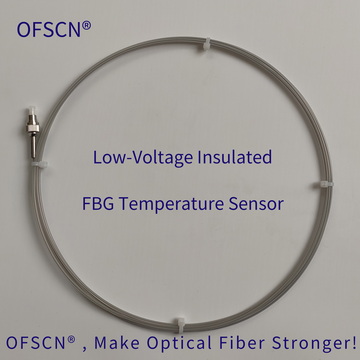
OFSCN® 150 Low-Voltage Insulated Fiber Bragg Grating Temperature Sensor
- Technical Advantages: Designed specifically for power systems, it uses polymer insulated composite material protection and is suitable for temperature measurement in medium and low-voltage distribution systems, busbars, and cable joints from -40\text{ ℃} to 150\text{ ℃}, providing reliable electrical insulation.
- Standard Images:



In summary, due to their unique physical properties, fiber optic patch cords do not need to worry about any electromagnetic interference when routed directly alongside high-voltage cables. However, in practical engineering applications, it is still necessary to select fully insulated, non-metallic encapsulated sensors and optical cables based on the specific voltage level and electric field strength to ensure the electrical safety of the entire high-voltage system.