Why do products undergo high and low temperature cycle testing before leaving the factory? OFSCN®
Fiber optic splitters (including Planar Lightwave Circuit PLC splitters and Fused Biconical Taper FBT splitters) undergo high and low temperature cycling tests (TCT) before leaving the factory, which is the most critical part of Environmental Stress Screening (ESS). From the perspectives of physics and engineering reliability, its core objectives are primarily the following three points:
1. Residual Stress Relaxation due to Heterogeneous Material Integration
A fiber optic splitter is a precision optical component assembled from multiple dissimilar materials. These materials have significant differences in their coefficients of thermal expansion (CTE, usually denoted as \alpha). For example:
- Silicon dioxide (\text{SiO}_2) waveguide chip (\alpha \approx 0.5 \times 10^{-6}\text{/K})
- Monocrystalline silicon (\text{Si}) substrate (\alpha \approx 2.6 \times 10^{-6}\text{/K})
- Cured optical adhesive (whose CTE is typically as high as 10 \times 10^{-6}\text{/K} to 100 \times 10^{-6}\text{/K}, 1-2 orders of magnitude higher than inorganic materials)
- Stainless steel or ceramic protective casing
During the manufacturing and adhesive curing processes, residual stresses inevitably accumulate within the device due to temperature variations and curing shrinkage. The high and low temperature cycling test, through alternating thermal loads, forces these heterogeneous materials to expand and contract periodically. It utilizes the micro-creep of the adhesive and the thermal relaxation of materials to release and balance the internal residual mechanical stresses. This effectively prevents micron-level drift of the optical alignment structure caused by slow stress relaxation during long-term service.
2. Screening Latent Process Defects and Reducing Infant Mortality
According to the “Bathtub Curve” in reliability engineering, components have a higher failure rate in the early stages of their lifecycle. Common causes of early failure for fiber optic splitters include:
- Microscopic contamination or incomplete curing at the optical adhesive interface
- Slight initial misalignment between the fiber array (FA) and the waveguide facet
- Micro-cracks on the bare fiber surface or brittle silicon substrate
The alternating high and low temperatures generate immense thermo-mechanical shear stress at the interfaces between different materials (its magnitude is proportional to the temperature difference \Delta T and the difference in coefficients of thermal expansion \Delta \alpha, i.e., stress \sigma \propto \Delta\alpha \cdot \Delta T). By cyclically applying this coupled thermal and mechanical stress, defective devices are forced to expose and fail before leaving the factory (e.g., cracking of the optical adhesive layer, complete misalignment of the alignment structure leading to a drastic increase in insertion loss), thus eliminating potential “infant mortality” issues in the laboratory.
3. Verifying the Stability of Optical Parameters at Extreme Temperatures
The core optical parameters of fiber optic splitters—such as insertion loss (\text{IL}), uniformity, and polarization-dependent loss (\text{PDL})—must remain stable across a wide operating temperature range (in compliance with industry standards like Telcordia GR-1209-CORE and GR-1221-CORE). The high and low temperature cycling test verifies whether the internal optical path and packaging structure of the splitter can maintain its original high-fidelity coupling efficiency at extreme ambient temperatures.
Related Products and Applications
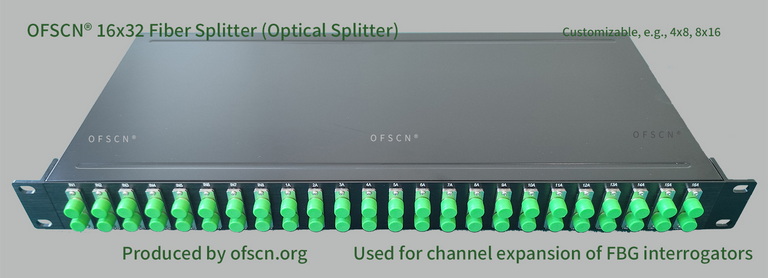
In large-scale Fiber Bragg Grating (FBG) sensing networks, fiber optic splitters are typically used in conjunction with FBG interrogators to logically expand the number of channels within a single physical channel.
To ensure the long-term reliability of sensing systems in harsh industrial environments, Beijing Dacheng Yongsheng Technology Co., Ltd. offers industrial-grade fiber optic splitter products that have undergone rigorous high and low temperature testing:
OFSCN® Optical Fiber Splitter
Standard specifications include 16x32 splitters, 8x16 splitters, 4x8 splitters, and 32x64 splitters. These splitters are commonly used in large engineering projects, paired with the OFSCN® Fiber Bragg Grating Interrogator for multi-channel logical expansion, thereby reducing the deployment cost per channel in multi-point monitoring systems. When designing the system, careful consideration must be given to the planning of sensing wavelengths.