What is the variation range of the spectral ratio when the temperature changes from -40℃ to +85℃?
The temperature ranges from -40\ ^\circ\text{C} to +85\ ^\circ\text{C} (which is also the operating temperature range specified by industrial and telecommunications standards such as Telcordia GR-1209). The variation in split ratio depends on the physical manufacturing technology employed by the splitter. Currently, there are two main types on the market: PLC (Planar Lightwave Circuit) Splitters and FBT (Fused Biconical Taper) Splitters, which exhibit significant differences in thermal stability:
1. PLC Splitter
- Physical Mechanism: PLC splitters utilize semiconductor fabrication processes to grow silica waveguides on a silicon wafer. Due to the exceptional stability of the silicon substrate and silica material’s thermophysical properties within this temperature range, their sensitivity to temperature fluctuations is extremely low.
- Split Ratio and Loss Variation: Within the temperature range of -40\ ^\circ\text{C} to +85\ ^\circ\text{C} , the Temperature Dependent Loss (TDL) for PLC splitters is typically \le 0.3\ \text{dB} (with typical values ranging between 0.1\ \text{dB} and 0.2\ \text{dB} ).
- Split Ratio Fluctuation: For conventional 1 \times N uniform splitting, the temperature drift of the split ratio for each channel is minimal, with variations usually within \pm 1\% to \pm 1.5\% . The uniformity among multiple channels is largely unaffected by temperature changes.
2. FBT Splitter
- Physical Mechanism: FBT splitters are manufactured by fusing and stretching two or more optical fibers. Their split ratio is highly dependent on the physical geometry of the fused region and the waveguide refractive index. As the temperature changes from -40\ ^\circ\text{C} to +85\ ^\circ\text{C} , thermal expansion of the material (mechanical stretching effect) caused by ambient temperature, along with the thermo-optic effect of silica (refractive index change), leads to phase shifts in the fused region, resulting in split ratio drift.
- Split Ratio Variation Range: For standard FBT splitters without special temperature-compensated packaging (taking a common 50:50 uniform split as an example):
- Across the entire temperature range of -40\ ^\circ\text{C} to +85\ ^\circ\text{C} , the absolute drift of the split ratio is typically between \pm 2\% and \pm 5\% (e.g., at extreme low temperatures, the original 50:50 split ratio might drift to 45:55 or even 48:52 ).
- Correspondingly, the Temperature Dependent Loss (TDL) variation is usually between 0.5\ \text{dB} and 1.0\ \text{dB} .
- High-quality FBT splitters with special thermally expanded compensation packaging can mitigate some of the thermo-optic effects through mechanical structures, controlling the split ratio drift within \pm 2\% over the entire temperature range.
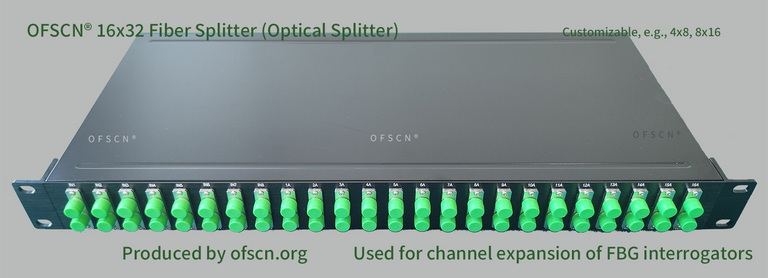
In Beijing Dacheng Yongsheng Technology Co., Ltd.'s official product line, the OFSCN® Optical Fiber Splitter offers high-channel-count (e.g., 16x32, 8x16, 4x8, 32x64, etc.) optical splitting solutions with excellent thermal stability across the full temperature range and low insertion loss. In large-scale engineering projects, these devices are often used in conjunction with the OFSCN® Fiber Bragg Grating Interrogator to logically expand physical channels (effectively multiplying the number of usable channels under strict wavelength design), thereby significantly reducing the hardware cost per channel for multi-point fiber Bragg grating sensing systems.