What are the advantages in terms of temperature resistance and cost for splitters produced using this traditional craftsmanship?
This involves the use of
Fused Biconical Taper (FBT) is a classic passive optical component manufacturing process. Its basic principle is as follows: two (or more) optical fibers, with their coatings removed, are brought into close proximity in a specific arrangement. Under high-temperature heating, they are fused and simultaneously stretched from both sides, forming a biconical coupling region in the heated zone. By controlling the stretching length and angle, the coupling and distribution of optical power between the two fibers can be precisely managed.
Compared to planar lightwave circuit (PLC) splitters manufactured using modern semiconductor processes, FBT splitters offer distinct scientific and engineering advantages in terms of temperature resistance and production cost:
1. Temperature Resistance Advantages
- All-Fiber Integrated Structure: The coupling region of an FBT splitter is formed by directly fusing optical fibers (high-purity silica glass), ensuring high consistency in their coefficients of thermal expansion (CTE). In contrast, PLC splitters consist of silicon-based chips, V-grooves, and input/output fiber arrays. Multi-layer interfaces of dissimilar materials, often bonded with adhesives, are prone to thermal stress mismatches due to temperature variations.
- Adhesive-Free Coupling Region: The optical coupling in FBT occurs entirely within the fused fiber body, eliminating the need for high-precision optical adhesives (such as UV glue) in the core optical path. This prevents issues like aging, yellowing, or delamination of the adhesive at high temperatures (e.g., above 100\ ^\circ\text{C}) or low temperatures, making it easier to customize into highly temperature-resistant devices through special packaging techniques.
- Wide Operating Temperature Range: Standard FBT devices can operate stably in ambient temperatures ranging from -40\ ^\circ\text{C} to +85\ ^\circ\text{C}. With special metal tube packaging or the use of high-temperature resistant fiber materials (such as polyimide-coated fibers), they can even withstand more extreme operating temperatures.
2. Cost Advantages
- Extremely Low Equipment Barrier and Initial Investment: FBT manufacturing primarily relies on fiber tapering machines and heating sources (like oxy-hydrogen flames or micro graphite resistance furnaces). It does not require the expensive front-end processes like photolithography, plasma etching, or chemical vapor deposition (CVD), nor the cleanroom environments demanded by PLC technology. Consequently, the initial equipment depreciation and operational costs for FBT production lines are very low.
- High Cost-Effectiveness for Low Channel Count Splitters: For conventional splitters with low channel counts, such as 1 \times 2, 1 \times 3, or 1 \times 4, FBT offers a decisive cost advantage. This is because PLCs, regardless of the number of output channels, must undergo complete lithography and complex end-face coupling alignment. Therefore, low-channel-count PLC splitters are economically less viable.
- Flexible Custom Split Ratios: The FBT process allows for the real-time monitoring of output power during the tapering process, enabling the customization of asymmetric split ratios (e.g., 90:10, 95:5, 99:1). This capability is highly valuable in applications like trunk monitoring and fiber sensor networks (e.g., for cascading channels with fiber Bragg grating interrogators). In contrast, PLCs are typically designed for equal splitting or fixed symmetric configurations (1 \times N equal split) and lack the flexibility for non-equal ratio customization.
Beijing Dacheng Yongsheng Technology Co., Ltd. (OFSCN®) Product Recommendations
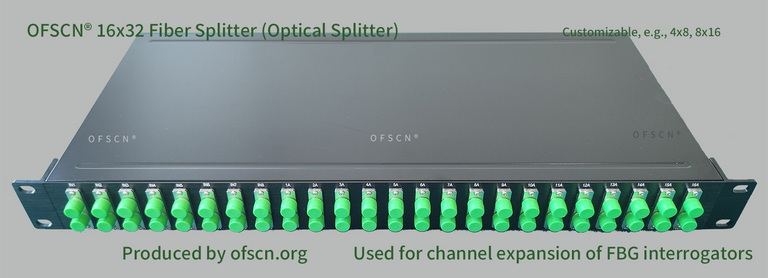
In large-scale distributed fiber optic monitoring projects or complex FBG (Fiber Bragg Grating) sensing systems, optical splitters are often utilized to expand the physical channels of interrogators, allowing more sensors to be connected in series or parallel on a limited number of physical channels. Beijing Dacheng Yongsheng Technology Co., Ltd. (OFSCN®) provides professional passive optical component support to meet the high-reliability application demands across various operating conditions:
- OFSCN® Optical Fiber Splitter can be adapted for fiber Bragg grating interrogators. Through wavelength design, it logically expands a single physical channel into multiple channels, effectively reducing the average unit cost per channel in the system.
Furthermore, for fiber optic systems requiring operation in extreme temperature environments (such as high temperatures), Beijing Dacheng Yongsheng also offers a series of excellent temperature-resistant connection devices: