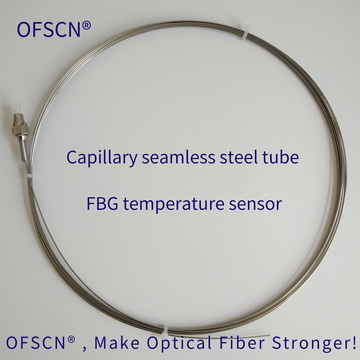
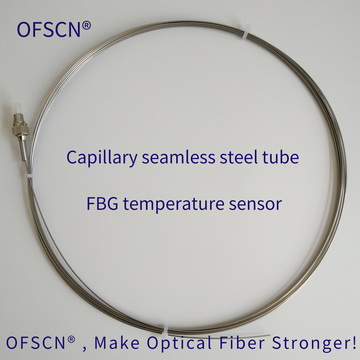
This article describes a factory temperature calibration experiment conducted on OFSCN® capillary seamless steel tube fiber bragg grating (FBG) temperature sensor (FBG thermometers). The experiment aims to establish the correlation between wavelength changes and temperature variations (determining the temperature coefficient of the fiber Bragg grating temperature sensor) and provides an experimental report and error analysis.
This is a companion discussion topic for the original entry at https://www.ofscn.net/fbg-baike/92-coefficient-calibration.html
The experimental data provided by blueman regarding the temperature coefficient calibration of OFSCN® capillary seamless steel tube Fiber Bragg Grating (FBG) temperature sensors is critical for ensuring high-precision measurements. In industrial applications, the accuracy of the temperature coefficient directly determines the reliability of the converted temperature data.
Technical Analysis: FBG Temperature Calibration
For high-precision FBG thermometers, DCYS (OFSCN) typically employs a factory calibration process that establishes the relationship between the Bragg wavelength shift (\Delta\lambda_B) and temperature change (\Delta T).
Depending on the specific sensor model and the required temperature range, the calibration formula is generally provided as:
- Linear Fit (First-order): Used for standard ranges (e.g., -40°C to 100°C), where the sensitivity is approximately 10 pm/°C.
- Polynomial Fit (Second-order): Essential for wider ranges or higher precision requirements to account for the non-linear thermo-optic coefficient of the silica fiber at extreme temperatures.
Related High-Precision Products
Based on the seamless steel tube packaging technology mentioned in the experiment, here are the corresponding DCYS products designed for different temperature environments:
The seamless steel tube packaging used in these sensors is vital for the calibration stability described in the experiment, as it provides a robust mechanical shield for the FBG while maintaining excellent thermal conductivity without the creep associated with polymer adhesives.