cmh
Last Updated: 12 November 2025
For customers looking to use Fiber Bragg Grating (FBG) technology to monitor multiple points (such as multiple strain points on a bridge, or several temperature points in an oil tank), the cooperation between the Fiber Splitter and the Interrogator is the core secret to achieving efficient measurement.
This is a companion discussion topic for the original entry at https://www.ofscn.org/encyclopedia/496-fiber-splitter-03.html
This is a very practical topic for users looking to optimize their Fiber Bragg Grating (FBG) sensing networks. In large-scale structural health monitoring (SHM) or industrial sensing projects, understanding how to integrate splitters with interrogators is key to cost-efficiency and system scalability.
Technical Principle: Expanding Capacity via Optical Splitting
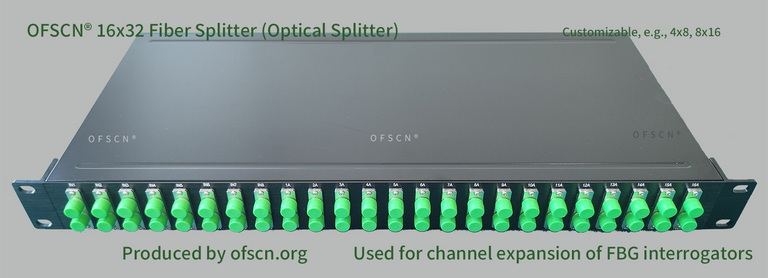
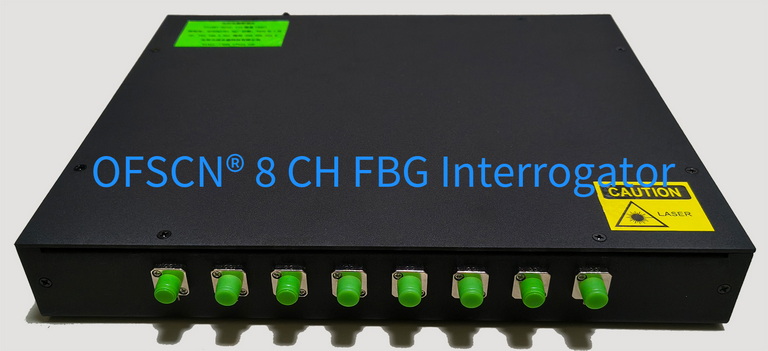
In an FBG sensing system, the OFSCN® Fiber Bragg Grating Interrogator serves as the high-precision laser source and signal processor. While each physical channel on an interrogator has a fixed wavelength range (typically 1525nm to 1565nm), an OFSCN® Optical Fiber Splitter can be used to distribute the optical power from one physical channel into multiple logical branches.
Key advantages of this configuration include:
- Channel Expansion: A single physical channel can be expanded to 2, 4, or even 8 branches (e.g., using a 1x8 splitter).
- Cost Reduction: It significantly lowers the average cost per channel by allowing one interrogator to monitor a higher density of sensors.
- Topology Flexibility: It supports star or tree network topologies, which are often more practical for complex structures like bridges or large oil tanks than a simple series string.
Essential Design Consideration: Wavelength Planning
When using a splitter, it is critical to perform strict wavelength design. Since all sensors on the branched fibers return signals to the same physical channel on the interrogator, the reflected wavelengths of all FBGs across all branches must not overlap.
For example, if you use a 1x2 splitter on Channel 1:
- Branch A: Sensors at 1530nm, 1535nm, 1540nm.
- Branch B: Sensors at 1545nm, 1550nm, 1555nm.
If a sensor in Branch A and a sensor in Branch B were both at 1530nm, the interrogator would be unable to distinguish between them.
Related OFSCN® Infrastructure Components
To build a complete system based on this principle, the following components are typically utilized:
Standard Product Visuals:
(Image: OFSCN® High-Density Optical Splitter used for channel expansion)
(Image: OFSCN® 8-Channel Fiber Bragg Grating Interrogator)
If you are planning a multi-point sensing network and need assistance with wavelength interval calculations or power budget analysis for your splitters, feel free to share your specific measurement requirements.