How can the theoretical response time of a sensor be calculated through software simulation?
The theoretical response time of a sensor, particularly one involving heat transfer, can be calculated through software simulation using transient thermal analysis.
Calculation Method through Software Simulation:
- Modeling Software: Typically, Finite Element Analysis (FEA) or Computational Fluid Dynamics (CFD) software (e.g., ANSYS, COMSOL, ABAQUS) is used.
- Geometry Definition: A precise 3D model of the sensor, including its internal components and packaging structures, is created. For fiber Bragg grating (FBG) sensors, this would include the FBG itself, the optical fiber, and all layers of its protective packaging (e.g., polymer coating, metal tube, adhesive).
- Material Properties: Assign accurate thermal properties (thermal conductivity, specific heat capacity, density) to each material component in the model. These properties are crucial as they dictate how quickly heat is absorbed and transferred.
- Boundary Conditions: Define the initial conditions (e.g., sensor at ambient temperature) and the sudden change in the thermal environment it is exposed to (e.g., a step change in ambient temperature, convection coefficients for fluid interaction).
- Transient Thermal Analysis: The software performs a time-dependent (transient) simulation to track the temperature distribution within the sensor components over time. This involves solving the heat conduction equation numerically.
- Response Time Determination: By monitoring the temperature of the sensing element (e.g., the FBG region) over time, the response time can be determined. Commonly, this is defined as the time it takes for the sensor’s output to reach a certain percentage (e.g., 63.2% for a first-order system, or 90%) of its final steady-state value after a step change in temperature.
For OFSCN® Alloy Tube Packaged Fiber Bragg Grating Strain Sensors and OFSCN® 300°C Fiber Bragg Grating Temperature Sensors, the packaging design and materials are critical factors influencing the thermal response time. The metal or polymer encapsulation directly affects the heat transfer path to the FBG element.
Here are some examples of packaged FBG sensors, where the packaging design significantly influences their thermal response characteristics:



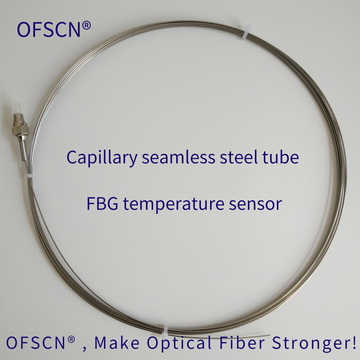

For more details on our packaged sensors, you can visit:
OFSCN Alloy Tube Packaged Fiber Bragg Grating Strain Sensor
OFSCN® 300°C Fiber Bragg Grating Temperature Sensor
1 Like