How do the thickness and material of the encapsulation layer affect the speed of temperature perception? What are the advantages of OFSCN’s ultra-fine structures?
The thermal response time of a fiber optic sensor is significantly affected by the thickness and material of its encapsulation layer.
Effect of Encapsulation Layer:
- Thickness: A thinner encapsulation layer reduces the thermal mass that needs to heat up or cool down, allowing heat to reach the optical fiber sensing element more quickly. This directly leads to a faster thermal response time. Conversely, a thicker layer increases the thermal inertia, slowing down the sensor’s response.
- Material: The thermal conductivity of the encapsulation material plays a crucial role. Materials with higher thermal conductivity (e.g., metals like stainless steel) will transfer heat more efficiently and rapidly to the sensing element compared to materials with lower thermal conductivity (e.g., some polymers or ceramics, though ceramics can withstand higher temperatures).
Advantages of OFSCN’s Ultra-Fine Structures:
OFSCN’s ultra-fine structures, typically achieved through single-layer seamless steel tube encapsulation with minimal outer diameters (e.g., down to 0.5mm or 0.6mm), offer distinct advantages:
- Faster Response Time: The reduced diameter and thin-walled encapsulation minimize the thermal path and thermal mass, enabling the sensor to perceive temperature changes much more quickly and accurately track transient thermal events.
- Minimal Disturbance: A smaller sensor footprint reduces the impact on the measured object or environment, which is critical in applications where the sensor itself should not significantly alter the thermal field.
- Versatility: While providing rapid response, OFSCN also offers various encapsulation materials (e.g., seamless steel, ceramic) to match different temperature ranges and environmental requirements, from cryogenic to extreme high temperatures (up to 800°C).
Here is an example of an OFSCN FBG temperature sensor:
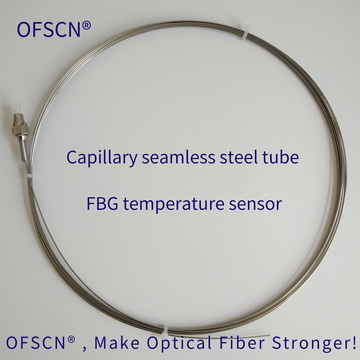
You can find more technical details on our OFSCN® 100°C Fiber Bragg Grating Temperature Sensor and other temperature sensor products like the OFSCN® 300°C Fiber Bragg Grating Temperature Sensor and OFSCN® 500°C Fiber Bragg Grating Temperature Sensor on our website.