If placed in the Mariana Trench at a depth of 10,000 meters, can optical fibers still transmit signals?
In the Mariana Trench at a depth of 10,000 meters (water pressure of approximately 100\ \text{MPa} / 1000\ \text{bar} ), optical fibers are fully capable of transmitting optical signals normally.
From the perspectives of optical physics mechanisms and engineering material mechanics, the specific principles are as follows:
I. Physical Mechanisms and Material Mechanics Analysis
-
High Compressive Strength of Quartz Glass
- Quartz glass (\text{SiO}_2) is a high-strength inorganic non-metallic material. Although quartz is sensitive to tensile stress (tensile strength) caused by localized microcracks, its theoretical compressive strength limit exceeds several \text{GPa}.
- At a depth of 10,000 meters in the deep sea, the pressure of approximately 100\ \text{MPa} (0.1\ \text{GPa}) is uniform isotropic hydrostatic pressure. Under this pressure, the quartz lattice only undergoes slight volumetric elastic compression, far from reaching the material’s yield or collapse limit, and the optical fiber structure itself will not be crushed.
-
Stable Optical Waveguide Structure and Total Internal Reflection Mechanism
- Optical fiber guidance relies on the refractive index difference between the core and the cladding (n_{\text{core}} > n_{\text{cladding}}).
- Although hydrostatic pressure can cause a slight increase in the refractive index of quartz through the photoelastic effect (the change is usually extremely small), because the core and cladding materials are compressed isotropically under the same hydrostatic pressure, the refractive index difference between them remains basically constant. The condition for total internal reflection guiding is not destroyed, and optical signals can still be transmitted stably.
II. Practical Engineering Challenges in Deep-Sea Environments
Although ideal hydrostatic pressure does not impair the light-guiding capability of optical fibers, direct laying of bare optical fibers in the deep sea faces the following engineering challenges:
- Localized Non-uniform Stress and Microbending Loss: If the seabed is rough, has heterogeneous contact, or experiences lateral point pressure, non-uniform stress will cause micron-level bending of the fiber core axis, leading to the leakage of guided mode energy into radiation modes and causing severe signal attenuation.
- Water Molecules and Hydrogen Loss (Hydrogen Attenuation): Under long-term erosion by high water pressure, water molecules easily accelerate the expansion of microcracks on the glass surface (stress corrosion cracking), and the permeation of hydrogen molecules into the fiber core causes absorption loss in specific wavelength bands (e.g., 1383\ \text{nm}).
III. Engineering Solutions: Seamless Metal Tubes and High-Pressure Armoring
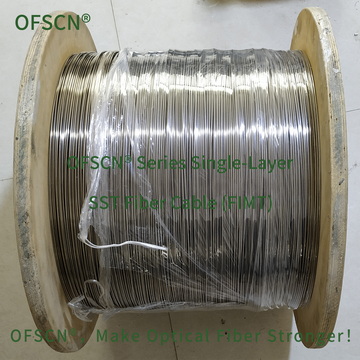
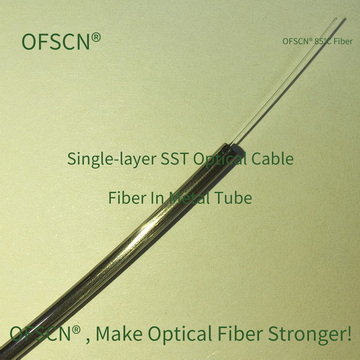
To isolate the deep-sea water pressure and harsh environment, optical fiber oil paste loose tubes and seamless metal tube (FIMT) encapsulation structures are commonly used, placing the optical fibers inside a metal protective casing to completely counteract external lateral pressure and seawater erosion.
In specialized optical fiber engineering and harsh industrial environments, such as the seamless steel tube optical cables and patch cords developed by Beijing Dacheng Yongsheng Technology Co., Ltd., their compressive strength indicators have been rigorously tested:
- OFSCN® 2.0mm Micro Steel Armored Fiber Optic Patch Cord (Compressive strength \gt 150\ \text{MPa} )
- OFSCN® 3.0mm Steel Wire Rope Fiber Optic Patch Cord (Compressive strength \gt 200\ \text{MPa} )
- OFSCN® 85°C Seamless Steel Tube Fiber Cable (Encapsulated with high-strength stainless steel seamless steel tubes)
Conclusion: Whether from the physical limit of hydrostatic pressure for quartz glass itself, or from modern metal armored sealing encapsulation technology, optical fibers can reliably transmit optical signals in the deep-sea environment at 10,000 meters.