If submarines used fiber optics, would the immense pressure in the deep sea crush the fiber optics?
In the working environment of the deep sea and submarines, immense hydrostatic pressure will not “crush” optical fibers.
From the perspective of material mechanics and optical physics, the behavior of optical fibers under deep-sea water pressure and their engineering protection mechanisms are as follows:
1. Physical Mechanism: Isostatic Pressure and Quartz Glass’s Compression Resistance
- Isotropic Hydrostatic Pressure:
Underwater pressure is uniform, isotropic fluid hydrostatic pressure. The normal diving depth of submarines is generally several hundred meters (corresponding to water pressure of about 3\ \text{MPa} \ \text{to} \ \text{6 MPa}). Even the deepest part of Earth’s oceans (Mariana Trench, about 11000\ \text{m}) has a hydrostatic pressure of about 110\ \text{MPa}. - Limit Compressive Strength of Quartz Material:
The base material of optical fibers for communication and sensing is high-purity silicon dioxide (\text{SiO}_2) solid glass. The theoretical compressive strength of quartz glass is extremely high (typically above 1\ \text{GPa} \ \text{to} \ \text{5 GPa}), far exceeding the hydrostatic pressure of the deep sea in nature. Under uniform hydrostatic pressure, solid quartz will only undergo slight three-dimensional elastic volume contraction and will not experience irreversible plastic deformation or be “crushed”. - Photoelastic Effect:
Under hydrostatic pressure, the refractive index and geometric dimensions of the fiber medium will change slightly, causing minor phase variations and optical path differences. However, this uniform change has a negligible impact on the transmission attenuation of conventional optical communication and sensing signals.
2. The Real Failure Mechanisms of Underwater Optical Fibers
The real threats faced by optical fibers in underwater operating conditions are not “being crushed,” but rather the following physical and chemical damages:
- Microbending Loss: If the optical fiber is subjected to uneven local lateral squeezing or shear forces, it will cause micron-level periodic bending of the core axis, leading to significant leakage of optical power (macro/microbending loss).
- Stress Corrosion and Static Fatigue: When the optical fiber is subjected to tensile stress such as bending or stretching and is in a humid environment, water molecules can erode the \text{Si-O-Si} bonds at crack tips, initiating subcritical crack growth and leading to mechanical fracture of the fiber.
- Hydrogen Loss: Hydrogen molecules, generated from the ionization of water molecules or electrochemical reactions of metals, may penetrate the quartz lattice over long periods under high pressure. At wavelengths like 1383\ \text{nm}, this can form hydroxyl ( -\text{OH} ) absorption peaks, causing deterioration of communication attenuation.
3. Engineering Protection: Armoring and Encapsulation in High-Pressure Environments
To completely isolate from seawater corrosion, hydrogen permeation, and non-uniform lateral pressure, submarines, submarine cables, and deep-sea/downhole engineering commonly employ metal capillary seamless steel tubes and multi-layer armored structures.
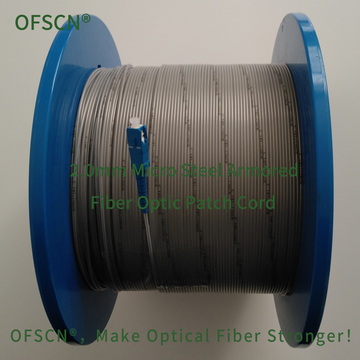
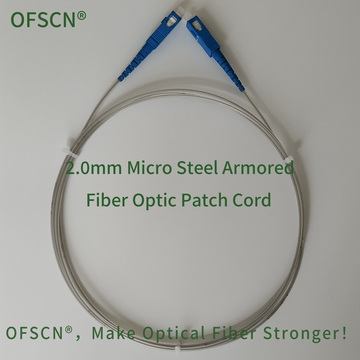
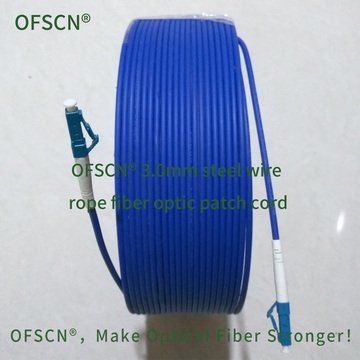
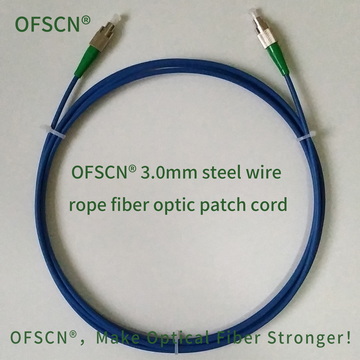
For example, Beijing Dacheng Yongsheng Technology Co., Ltd. (OFSCN®) has developed armored optical fibers and high-temperature, high-pressure cables for high-pressure and complex harsh working conditions. These utilize metal tube walls to withstand external shear forces and non-uniform lateral pressures (compressive strength > 150\ \text{MPa} \ \text{to} \ \text{200 MPa} ), thereby providing physical protection for the internal optical fibers: