Will the jumper cable sheath swell after prolonged immersion in seawater?
Whether the polymer outer sheath of fiber optic patch cords will experience “swelling” when immersed in seawater for a long time mainly depends on the chemical composition of the outer sheath polymer, the degree of crosslinking, and the additive system.
I. Swelling and Degradation Mechanism of Sheath Materials in Seawater
Swelling refers to the physical/chemical process where low-molecular solvents (such as water molecules) penetrate into the polymer matrix driven by chemical potential gradients, expanding the spacing between molecular chains, disrupting intermolecular secondary bonds, and thus leading to material volume expansion, increased mass, and reduced mechanical strength.
The performance of different sheath materials in seawater varies significantly:
- Conventional PVC (Polyvinyl Chloride) and LSZH (Low Smoke Zero Halogen Polyolefin) Sheaths (Common in General Indoor Patch Cords):
- Highly prone to swelling and aging: Conventional PVC sheaths contain a large amount of low-molecular plasticizers (such as phthalates). Prolonged immersion in high-salinity seawater not only causes water absorption and swelling but also gradual leaching of plasticizers, leading to embrittlement and cracking of the sheath after short-term swelling.
- LSZH materials, due to a high proportion of hydrophilic inorganic flame retardants (such as aluminum hydroxide, magnesium hydroxide), have high water absorption. Under seawater immersion, they are highly susceptible to significant water-induced swelling, accompanied by a sharp decline in tear strength.
- PE (Polyethylene) Sheath (Typical Material for Marine/Outdoor Optical Cables):
- Excellent resistance to swelling: PE is a non-polar, highly crystalline polymer with tightly packed molecular chains and no hydrophilic groups. Its saturated water absorption is extremely low (typically less than 0.01\% ). In long-term seawater immersion, PE sheaths exhibit virtually no swelling that is visually detectable or causes structural damage to the mechanical properties. It is the preferred moisture-proof sheath material for submarine optical cables.
II. Engineering Hazards of Sheath Swelling to Fiber Optic Systems
If the patch cord sheath absorbs water and swells, it will have the following direct impacts on the internal optical fibers:
- Additional Strain and Micro-bending Loss:
Polymer sheath swelling is usually anisotropic. The resulting axial tensile strain and radial compressive stress are transferred to the optical fiber core, causing tiny bends in the fiber and leading to a surge in loss at specific communication wavelengths. If used for FBG (Fiber Bragg Grating) sensing, it will introduce unpredictable additional wavelength drift, disrupting the measurement baseline. - Water Vapor Permeation and Fiber Mechanical Fatigue:
The swelling process is accompanied by the migration of water molecules. When water vapor penetrates the polymer sheath and comes into direct contact with the silica glass fiber, the hydroxyl ions ( \text{OH}^- ) in water molecules catalyze the expansion of micro-cracks on the fiber surface, accelerating static fatigue fracture of the fiber. Simultaneously, characteristic absorption peaks will form (e.g., hydrogen loss absorption peaks around 1383\ \text{nm} ).
III. Patch Cord Selection Scheme for Marine Environments
For applications involving seawater immersion, it is recommended to avoid conventional PVC/LSZH sheaths and instead opt for a composite structure with a high-density polyethylene (PE) protective outer layer combined with a stainless steel seamless pipe inner core, or use an all-metal sealed armored patch cord:
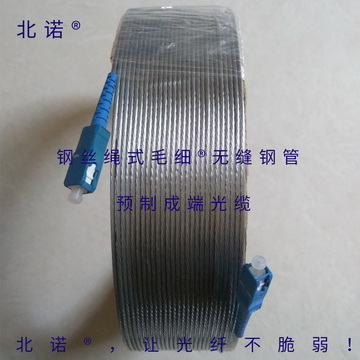
Scheme A: PE Outer Sheath + Steel Wire Stranding + Stainless Steel Seamless Pipe Composite Patch Cord
This structure features an outer PE sheath with excellent hydrolysis resistance and extremely low water absorption to isolate from seawater impingement and swelling. The inner layer uses a thick-walled stainless steel seamless pipe to achieve 100\% water vapor shielding and radial support, completely blocking the penetration of seawater hydrostatic pressure and salt into the fiber core.
- Matching Product: OFSCN® 3.0mm Steel Wire Rope Fiber Optic Patch Cord
- Structural Features: PE sheath + 0.45mm stainless steel wire stranding + 0.9mm stainless steel seamless pipe + optical fiber, tensile strength > 1200\ \text{N} , compressive strength > 200\ \text{MPa} .


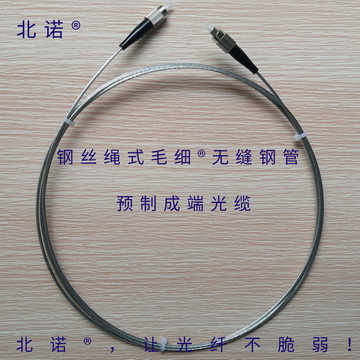
Scheme B: All-Metal Structure Armored Fiber Optic Patch Cord
This completely abandons organic polymer outer sheaths, eliminating the possibility of polymer swelling, hydrolysis, and biodegradation from a physical mechanism.
- Matching Product: OFSCN® 2.0mm Steel Wire Rope Fiber Optic Patch Cord
- Structural Features: Steel wire stranded outer layer + 1.0mm stainless steel seamless pipe + optical fiber, all-metal structure, tensile strength > 1500\ \text{N} , compressive strength > 150\ \text{MPa} . (Note: When used in high chloride ion seawater environments, attention should be paid to the anti-electrochemical corrosion and pitting protection design of the metal material).