Is the wavelength consistent at the same temperature during heating and cooling cycles?
Yes, ideally, the wavelength of an FBG sensor should be consistent at the same temperature during both heating and cooling cycles. However, in practical applications, a phenomenon known as hysteresis can sometimes be observed.
Explanation of Hysteresis in FBG Sensors:
Hysteresis in FBG temperature sensors primarily arises from the packaging materials and their interaction with the optical fiber, especially when there are differences in the thermal expansion coefficients between the fiber and the packaging. When the sensor is heated and then cooled, the stress distribution within the packaging and on the fiber may not return to its exact original state at a given temperature, leading to a slight difference in the measured Bragg wavelength.
Factors that can contribute to hysteresis:
- Packaging Material: Non-metallic or composite packaging materials, especially those involving adhesives, can introduce more hysteresis due to creep, relaxation, or uneven thermal expansion/contraction.
- Packaging Design: Poorly designed packaging that induces uneven stress on the fiber during temperature changes can exacerbate hysteresis.
- Temperature Range and Rate: Extreme temperature changes or rapid cycling can sometimes highlight hysteresis effects.
OFSCN Solution:
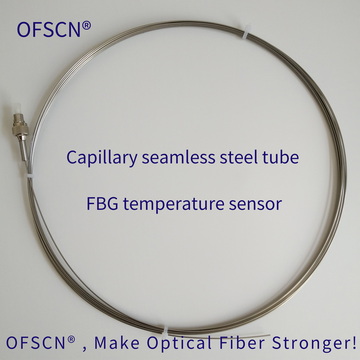
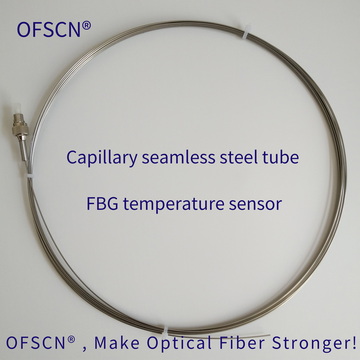
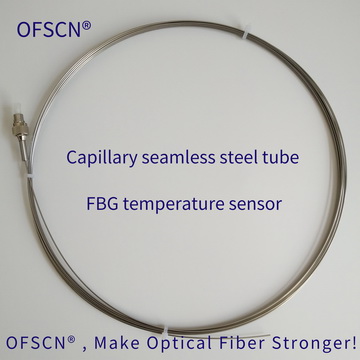
To minimize hysteresis and ensure high accuracy and repeatability, OFSCN® temperature sensors, particularly those designed for industrial and high-temperature applications, utilize all-metal seamless steel tube packaging. This design offers excellent mechanical protection and ensures a more consistent thermal transfer and stress distribution, significantly reducing hysteresis.
Here are some OFSCN® temperature sensor products that demonstrate high stability and minimal hysteresis:


For critical applications requiring high precision and long-term stability, selecting FBG sensors with robust, low-hysteresis packaging is essential.