How can wavelength inconsistency during heating and cooling cycles be reduced through material selection?
Wavelength inconsistency during heating and cooling cycles, commonly known as thermal hysteresis, in Fiber Bragg Grating (FBG) sensors primarily arises from the viscoelastic properties of the materials used in the sensor’s construction and packaging. Reducing this effect through material selection involves choosing components with highly stable thermal and mechanical characteristics.
Here are the key material selection strategies to minimize thermal hysteresis:
-
Fiber Coating Material Selection:
- Polyimide Coatings: For applications requiring operation up to 300°C, selecting an FBG inscribed in an optical fiber with a polyimide coating is crucial. Polyimide exhibits superior thermal stability and lower creep compared to standard polyacrylate coatings, leading to significantly reduced hysteresis.
- Bare Fiber / Femtosecond Gratings: For even higher temperatures (up to 800°C or more), bare fiber gratings (often fabricated using femtosecond laser technology) are preferred. The absence of a polymeric coating eliminates potential hysteresis contributions from the coating material itself at extreme temperatures.
-
Sensor Packaging Material Selection:
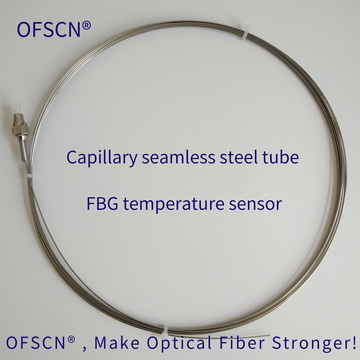
- All-Metal Encapsulation: The most effective way to reduce hysteresis in packaged FBG sensors, particularly for strain and temperature measurements, is to utilize all-metal, seamless tube encapsulation. This design eliminates the need for adhesives or potting compounds that can introduce viscoelastic effects and creep, especially at elevated temperatures. Metals with stable coefficients of thermal expansion ensure a consistent mechanical coupling to the FBG, preventing differential expansion or contraction that could lead to wavelength shifts during thermal cycling.
By carefully selecting fiber coatings with high thermal stability and employing robust, all-metal packaging solutions, the impact of hysteresis on precision measurements can be substantially mitigated.
For high-temperature applications requiring low hysteresis, you might consider products like the OFSCN® Alloy Tube Packaged Fiber Bragg Grating strain sensor or OFSCN® 300°C Fiber Bragg Grating Temperature Sensor, which leverage seamless metal tube encapsulation.
Here are some examples of such products: