How can accurate grating center wavelengths be extracted in weak signal environments?
In weak signal environments, extracting accurate grating center wavelengths is a significant challenge, as the signal-to-noise ratio (SNR) directly impacts demodulation accuracy. The primary goal is to enhance the SNR of the FBG reflection spectrum to ensure reliable wavelength detection.
To achieve accurate grating center wavelength extraction in such conditions, several technical considerations and approaches are crucial:
-
Improve Signal-to-Noise Ratio (SNR):
- Higher Optical Power: Using an interrogator with a higher output optical power can increase the reflected signal strength from the FBG, making it stand out more clearly from the noise floor.
- Low Noise Detection: Employing highly sensitive photodiodes and low-noise amplification circuits within the interrogator is essential to minimize the system’s inherent noise.
- Averaging: For static or slowly changing measurements, averaging multiple spectral scans can significantly reduce random noise components, thus improving the effective SNR.
- Optimization of FBG Characteristics: Using FBGs with higher reflectivity can enhance the reflected signal.
-
Advanced Signal Processing Algorithms:
- Peak Detection Algorithms: Algorithms specifically designed for noisy data, such as advanced centroid methods, Gaussian fitting, or polynomial fitting, can more robustly identify the FBG’s center wavelength.
- Filtering Techniques: Digital filters (e.g., moving average, Wiener filter) can be applied to the raw spectral data to smooth out noise before peak detection.
- Baseline Correction: Accurately identifying and subtracting the noise floor baseline is crucial to prevent baseline fluctuations from affecting wavelength calculations.
-
Interrogator Resolution and Accuracy:
- Wavelength Resolution: A high-resolution interrogator can better distinguish the FBG peak from closely spaced noise components.
- Wavelength Repeatability: An interrogator with high wavelength repeatability ensures that repeated measurements yield consistent results, even if the signal is weak.
OFSCN® provides high-performance Fiber Bragg Grating Interrogators that are designed with features to address these challenges, including customizable sampling frequencies and robust software supporting various integration protocols.
Here is a standard image of our interrogator:
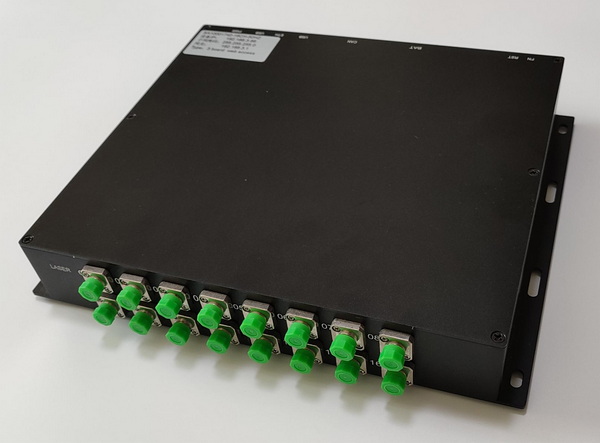
You can find more details about its features and specifications on our website.