Why does the fixture design directly determine the accuracy of strain measurements?
The accuracy of strain measurements is directly and significantly influenced by the fixture design because the fixture is the critical interface responsible for transferring the strain from the structure being monitored to the Fiber Bragg Grating (FBG) sensor.
Here’s why:
-
Direct Strain Transfer: FBG strain sensors operate by detecting changes in their grating period, which are induced by mechanical deformation (strain). For the sensor to accurately measure the strain of the object, the strain must be transferred from the object to the sensor precisely and completely. The fixture’s design dictates how effectively and reliably this transfer occurs.
-
Mechanical Coupling Integrity: A well-designed fixture ensures robust and consistent mechanical coupling. If there is any slippage, gaps, or non-uniform contact between the object, the fixture, and the sensor, the strain transfer will be compromised, leading to inaccurate or unreliable readings. For tube-type sensors, this often involves welding, clamping, or embedding, where the fixture’s geometry and attachment method are paramount.
-
Stress Distribution and Concentration: The fixture can influence the local stress field around the sensor. A poorly designed fixture might introduce stress concentrations, amplify or attenuate the actual strain, or distribute the strain non-uniformly across the sensor’s gauge length. This can lead to measurements that do not accurately represent the global or intended local strain of the object.
-
Environmental Factors and Long-term Stability: In harsh environments (e.g., high temperatures), the fixture must maintain its integrity and coupling performance over time. Factors like thermal expansion mismatch between the fixture and the monitored object, material creep, or fatigue in the fixture can introduce errors or lead to drift in measurements over long periods. OFSCN® installation fixtures are designed to address these challenges, ensuring stable and accurate measurements.
-
Minimizing Interference: The fixture should ideally isolate the sensor from unintended external forces or vibrations that are not related to the strain being measured, preventing noise and improving the signal-to-noise ratio.
For example, our OFSCN® Alloy Tube Packaged Fiber Bragg Grating strain sensor relies heavily on proper installation fixtures, often involving welding or specialized clamps, to ensure the strain from the structure is faithfully transmitted to the sensor.
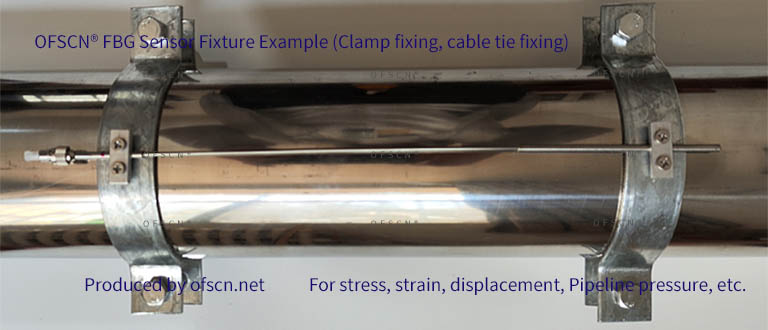
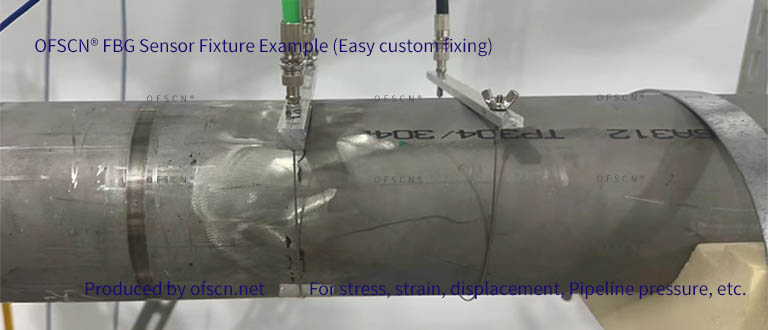
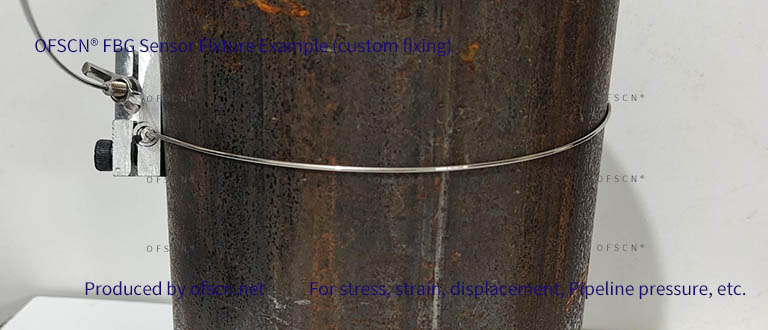
You can find more information about our fixture solutions here: OFSCN® Installation Fixture. Below are some standard images of our installation fixtures: