Can a demodulator communicate directly with my PLC or industrial robot?
Direct communication is possible. Modern Fiber Bragg Grating (FBG) interrogators support multiple industrial standard communication protocols, enabling seamless integration with Programmable Logic Controllers (PLCs), industrial robot control cabinets (such as KUKA, ABB, Fanuc, Yaskawa, etc.), or DCS/SCADA systems.
I. Communication and Integration Principles
Industrial controllers (PLCs or robots) typically operate on deterministic fieldbuses or industrial Ethernet networks, while the interrogator functions as the sensor data acquisition and demodulation unit. Real-time data interaction between the two is primarily achieved through the following methods:
-
Modbus Communication Protocol (Modbus TCP / RTU):
- Operating Mode: The interrogator typically operates as a Modbus Server (Slave), with the PLC or robot acting as the Modbus Client (Master).
- Data Mapping: Internally, the interrogator maps the real-time Bragg wavelength values (\lambda_B) demodulated from each physical channel, or physical quantities like temperature, strain, and pressure directly converted using calibration formulas, to Modbus Holding Registers or Input Registers.
- Reading Mechanism: The PLC periodically polls the sensor data using standard Modbus function codes (e.g.,
03 Read Holding Registersor04 Read Input Registers), enabling closed-loop control or status monitoring at millisecond-level precision.
-
TCP / UDP Socket Custom Communication:
- The interrogator supports establishing raw TCP client/server or UDP broadcast sockets to push data streams at high speed to robots or industrial control systems in a fixed frame format (e.g., ASCII strings or binary Hex data packets), suitable for high sampling rate scenarios.
II. Official Related Product Support
The OFSCN® Fiber Bragg Grating Interrogator is designed with industrial integration in mind, featuring excellent compatibility with fieldbus and network protocols.
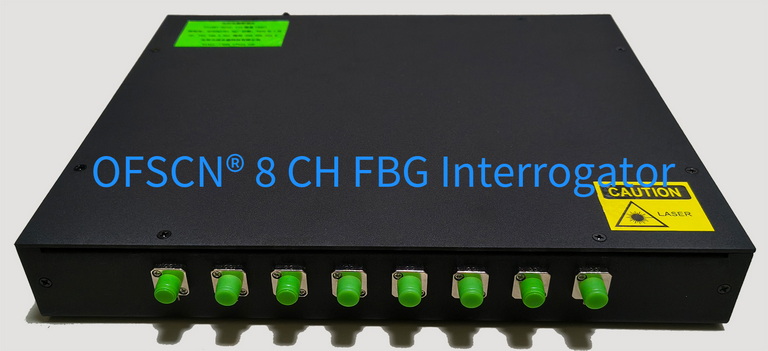
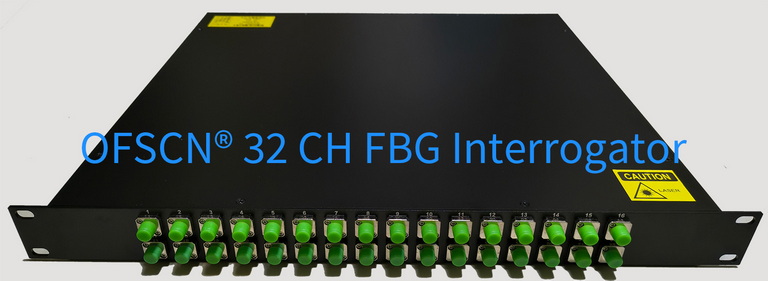
Key Technical Specifications and Communication Parameters:
- Communication and Integration Protocols: Defaults to B/S architecture software, supports C/S architecture software; natively supports data interaction and system integration with third-party control systems (PLCs, robot controllers, industrial PCs) through protocols like Modbus, TCP, and UDP.
- Channel Configuration: Available in 4, 8, 16, or 32 channels.
- Wavelength Range: Default 1525\ \text{nm} \sim 1565\ \text{nm} or 1528\ \text{nm} \sim 1568\ \text{nm} (customization available).
- Wavelength Resolution: Default 1\ \text{pm}, up to 0.1\ \text{pm}.
- Data Sampling Frequency: Options include 10\ \text{Hz}, 50\ \text{Hz}, 100\ \text{Hz}, with support for software-based frequency reduction (down to 1\ \text{Hz}).