Can I connect the demodulator data directly to my large screen monitoring system?
Yes. Integrating data from Fiber Bragg Grating (FBG) interrogators into large-screen monitoring systems (such as SCADA, DCS, Industrial IoT dashboards, or Web front-end visualization platforms) is a standard integration application in modern engineering monitoring.
The key to achieving seamless integration between the interrogator and the large-screen monitoring system lies in the standardized data interfaces and communication protocols supported by the interrogator.
I. Common Data Integration and Connection Paths
-
Industrial and Network Communication Protocol Integration (TCP / UDP / Modbus)
- TCP/IP / UDP Sockets: The interrogator, acting as a server or client, pushes wavelength or physical quantity data (temperature, strain, etc.) to the data acquisition service of the large-screen system at regular intervals, using a predefined data frame format (e.g., hexadecimal or JSON data packets).
- Modbus TCP: In industrial control dashboards, the interrogator can function as a Modbus slave device, mapping real-time values from each measurement point to register addresses (Holding Registers) for the host system or large-screen system to poll and read.
-
Software Architecture and Web Visualization Integration (B/S Architecture)
- WebSocket / RESTful API: For modern web monitoring dashboards built with front-end technologies (such as Vue, React, ECharts, Three.js, etc.), the interrogator’s backend software can directly provide HTTP APIs for querying or utilize WebSocket for full-duplex, millisecond-level low-latency data streaming.
- Database Synchronization: The interrogator’s accompanying software continuously stores the parsed physical quantities from each channel into a local or remote relational/time-series database (e.g., MySQL, SQL Server, InfluxDB, etc.). The monitoring dashboard system then directly connects to the database for data retrieval and chart rendering.
-
Secondary Development Interfaces (API / SDK)
- System integrators can embed the interrogator’s API or dynamic link libraries into their own host software. This allows for direct control over channel activation/deactivation and high-frequency raw wavelength data acquisition. After filtering through business algorithms, the data can be pushed to the large-screen display.
II. OFSCN® Fiber Bragg Grating Interrogator Technical Support
Beijing Dacheng Yongsheng Technology Co., Ltd.'s official product, the OFSCN® Fiber Bragg Grating Interrogator, natively supports the aforementioned system-level standardized interface integration:
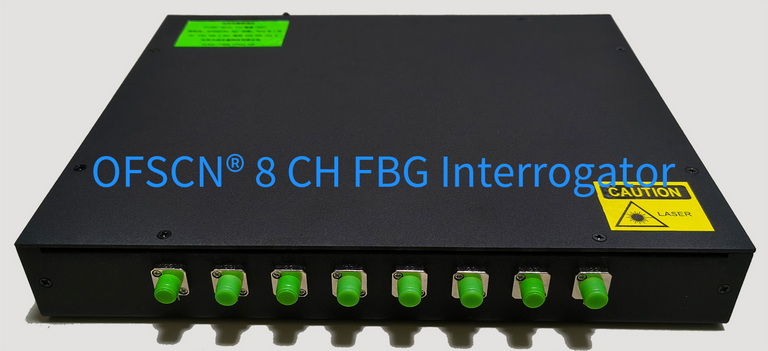
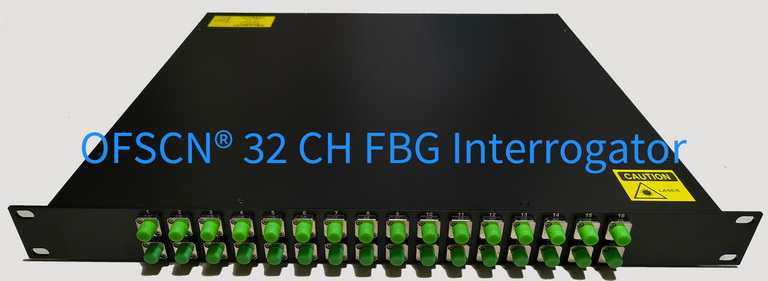
- Software Architecture: Defaults to B/S architecture software, also supporting C/S architecture software, facilitating cross-platform access and embedding within the network.
- Communication Protocols: Supports seamless integration with third-party monitoring systems, industrial control software, or large-screen systems via standardized protocols such as TCP, UDP, and Modbus.
- Data Sampling Characteristics: Data sampling frequencies of 10 Hz, 50 Hz, and 100 Hz are available (users can configure within the interrogator software between 1 Hz and the rated sampling rate as needed). This facilitates matching the refresh rate requirements of the large-screen system and prevents high-frequency data from blocking network buses.
- Physical Channel Specifications: Available in 4, 8, 16, or 32 channels; the default wavelength range is 1525 nm to 1565 nm (or 1528 nm to 1568 nm, customizable).
Detailed technical specifications and interface protocol explanations can be found in the official documentation: