cmh
Last Updated: 19 October 2025
In the field of fiber optic communication and sensing in extreme environments, different applications have strict requirements for the fiber mode. Whether it's long-distance transmission, high-speed data exchange, or precision sensing, specific types of fiber are needed to guarantee performance. The OFSCN® Specialty Fiber Optic Patch Cord Series, launched by Beijing Dacheng Yongsheng Technology Co., Ltd. (DCYS), offers a one-stop solution for Single-Mode (SM), Multi-Mode (MM), and Polarization-Maintaining (PM) fiber types, perfectly meeting all your requirements in harsh environments through its powerful customization and compatibility capabilities.
This is a companion discussion topic for the original entry at https://www.ofscn.org/encyclopedia/462-patch-cords-02.html
This is an excellent overview of the versatility offered by the OFSCN® specialty fiber optic patch cord series. As a pre-sales engineer, I would like to provide further technical details regarding how these different fiber modes (SM, MM, and PM) are integrated into our high-performance hardware.
To ensure the best performance in harsh environments, it is crucial to match the fiber mode with the appropriate protective structure and temperature rating.
Technical Mapping of OFSCN® Fiber Modes
-
Single-Mode (SM):
Most of our standard and high-temperature patch cords utilize OFSCN® G.652D or G.657 compliant fibers. These are ideal for long-distance sensing and telecommunications.
-
Multi-Mode (MM):
Designed for short-distance, high-bandwidth data transmission or specific sensing applications.
-
Polarization-Maintaining (PM):
Critical for fiber optic gyroscopes (FOG) and interference-based high-precision sensing where the polarization state must be preserved. We provide PM versions across our seamless steel tube series.
Structural Integration Examples
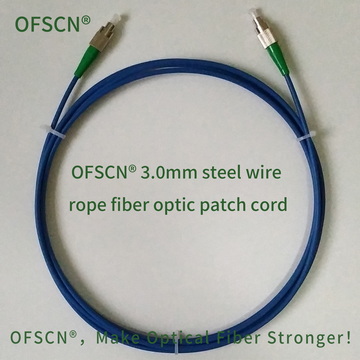
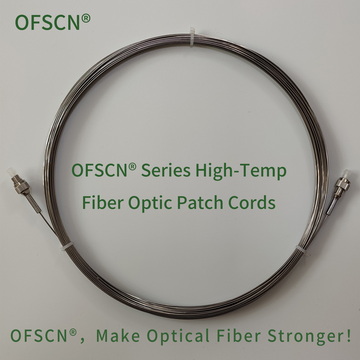
Depending on the mechanical requirements, these fiber modes can be encapsulated in different armored structures:
Standard Product Imagery:
For technical inquiries regarding the selection of core diameters (e.g., 50/125 vs 62.5/125 for MM) or the extinction ratio requirements for PM patch cords in specific industrial environments, feel free to discuss them here.