Is it representative of the fiber’s ability to be spliced?
Yes, your understanding is very intuitive and physically correct. In optics and fiber optics engineering, the Numerical Aperture (NA) can indeed be vividly understood as the fiber’s ability to “eat light” (i.e., collect and converge light rays from space).
1. What is the physical definition of Numerical Aperture (NA)?
From an academic physics perspective, Numerical Aperture is a dimensionless physical quantity that characterizes the angular range within which optical fibers can receive (or emit) light.
For the most common step-index profile fibers, the mathematical definition is:
\text{NA} = n_0 \sin \theta_{\max} = \sqrt{n_1^2 - n_2^2}
In an atmospheric (or vacuum) environment, the refractive index of air is n_0 \approx 1 , so the formula can be simplified to:
\text{NA} = \sin \theta_{\max} = \sqrt{n_1^2 - n_2^2}
Where:
- \theta_{\max} is the maximum angle of incidence for the fiber (also known as the half-acceptance angle or critical receiving angle). Only incident light within this cone of angles will undergo Total Internal Reflection (TIR) at the core-cladding interface and be guided within the core for propagation. Light entering at angles beyond this will refract into the cladding and be lost.
- n_1 is the refractive index of the fiber core.
- n_2 is the refractive index of the fiber cladding.
From this, we can see that: the larger the \text{NA} , the larger its maximum angle of incidence \theta_{\max} , and the wider the cone of space from which the fiber can “swallow” light.
2. Engineering Significance of “Light-Eating” Capability (NA) in Different Fibers
In different application scenarios, the physical considerations and design trade-offs for Numerical Aperture vary:
A. In Multimode Fibers and Large-Core Fibers: Pursuing Maximum “Light-Eating” Efficiency
For multimode fibers used in transmitting high-power lasers or for spectral energy collection, maximizing light coupling efficiency is typically a primary goal.
- A larger \text{NA} means it can more easily collect and couple light from sources with high divergence angles (such as the broad beams produced by semiconductor laser diodes (LDs) or LEDs).
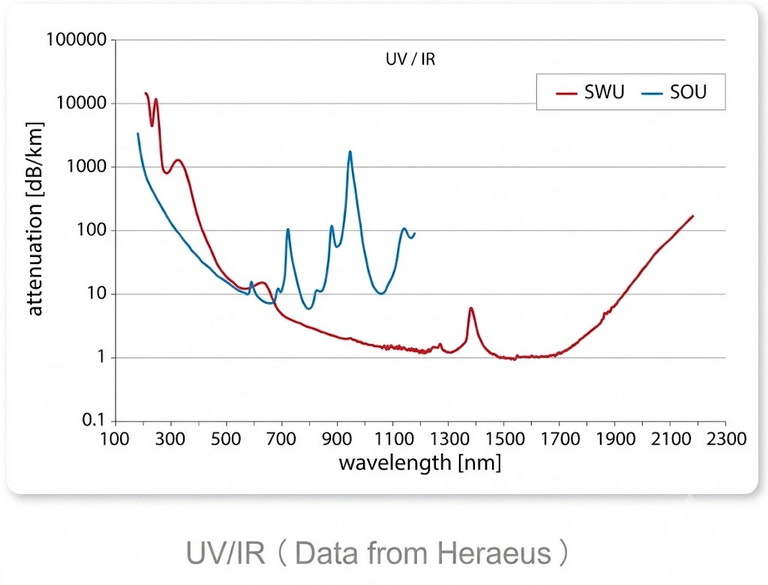
- For example, the OFSCN® Polyimide Large-Core Optical Fiber from Beijing Dacheng Yongsheng Technology Co., Ltd.'s specialty fiber series features a large core diameter and high Numerical Aperture designed for efficient spectral energy transmission and light collection in harsh, high-temperature environments.
B. In Single-Mode Fibers: Balancing “Light-Eating” with Field Confinement
For single-mode fibers, due to their very small core diameter (typically around 9\ \mu\text{m} ), they can only transmit a single fundamental mode. Consequently, their \text{NA} is relatively small (generally around 0.14 ).
- In this case, the magnitude of the \text{NA} is directly related to the fiber’s bend resistance.
- By increasing the core refractive index to increase the \text{NA} , the confinement of the optical field within the core is significantly enhanced. Bend-insensitive single-mode fibers (e.g., G.657 specifications) leverage this principle to tightly “confine” light even at extremely small bend radii, reducing losses caused by bending.
- Standard transmission fibers like OFSCN® G.652D Optical Fiber, and those with better bending performance like OFSCN® G.657 Optical Fiber, undergo extremely stringent control of the core-cladding refractive index difference during manufacturing to ensure their \text{NA} meets precise standards for modal dispersion and loss control.


3. Conclusion
What you described as “light-eating capability” is academically referred to as the light-gathering power of an optical fiber. Fibers with a large \text{NA} have a wider “reception window” and are less demanding in terms of collimation, making them easier to “eat light”; while small \text{NA} fibers, although requiring highly collimated incident light, possess irreplaceable physical advantages in ensuring high-quality single-mode transmission, controlling dispersion, and reducing optical field mode overlap.