How are hundreds of connectors neatly arranged in the rack?
In optical communication and fiber sensing engineering, securely and neatly arranging hundreds of fiber optic connectors (connectors) within a standard cabinet (typically 19-inch, approximately 482.6\text{ mm} wide) primarily relies on the Optical Distribution Frame (ODF) and strict cabinet cabling engineering specifications.
Here are the core physical and engineering design principles for achieving high-density, neat arrangements:
1. Modular & Drawer Design
Inside an ODF, hundreds of connectors are not haphazardly piled together but are managed hierarchically using modular splice and patch trays.
- Rack Unit (RU) Layering: Depending on space and density requirements, ODFs typically occupy 1\text{U}, 2\text{U}, or 4\text{U} ( 1\text{U} = 44.45\text{ mm}) of cabinet height.
- Drawer or Rotary Trays: A 1\text{U} ODF usually contains several trays that can be pulled out horizontally or rotated. Each tray is an independent management unit, typically integrating 12 or 24 fiber connections.
2. High-Density Adapter Panels
The neat fixing and quick plugging/unplugging of connectors depend on the array of fiber optic adapters (Adapters/Couplers) installed on the front of the trays:
- Interface Standardization: Common adapters include types such as FC, SC, LC, and ST.
- High-Density Arrangement: By using duplex or even quad adapters, more interfaces can be arranged in a minimal panel space. For instance, within a 1\text{U} space, using LC interfaces can easily achieve high-density arrangements of 96 or even 144 cores.
3. Strict Bending Radius Control
Optical fibers are extremely sensitive to bending. If the bending radius is too small, the total internal reflection condition within the fiber can be disrupted, leading to a sharp increase in macro-bending loss (denoted as \Delta \alpha) and even causing long-term fatigue fracture of the fiber.
- Cable Routing Rings and Spool Grooves: Within ODF trays and on the cabinet sides, there are curved guide rails, spools, and D-shaped rings.
- Physical Constraint: The physical dimensions of these accessories forcibly ensure that the fiber’s bending radius R always meets safety requirements. For standard G.652D single-mode fiber, a static bending radius of R \ge 30\text{ mm} is typically required; for bend-insensitive G.657 fiber, the bending radius can be reduced to R \ge 10\text{ mm} or even smaller.
4. Splice & Patch Integration
Multicore trunk optical cables introduced from the outside require their bare fibers to be fusion spliced with pigtails equipped with connectors. ODF trays are usually designed in layers or zones:
- Splicing Zone: Contains clamping slots for splice protection sleeves.
- Distribution Zone: Used for inserting adapters and connecting external patch cords.
- Excess Fiber Storage Zone: A certain length of excess fiber (typically tens of centimeters to one meter) is left and coiled in a circular shape within a storage groove, facilitating re-splicing in case of future link damage.
5. Routing Channels, Cable Managers, and Labeling Systems
- Cable Managers: In the front and sides of the cabinet ODF, there are vertical and horizontal comb-like cable managers or brush-lined routing channels. After a fiber patch cord is unplugged from the ODF interface, it immediately enters the routing channel, preventing the patch cord from sagging due to gravity and tangling with others.
- Polarity and Numbering Management: Each fiber core, each adapter port, and both ends of each patch cord are affixed with uniquely corresponding labels. The trays also have clear row and column numbering (e.g., A1 to A12), ensuring rapid and precise localization among hundreds of connectors.
About Beijing Dacheng Yongsheng Technology Co., Ltd. (OFSCN®) Product Line
Optical Distribution Frames (ODFs), as general network physical infrastructure, do not belong to the core product series of Beijing Dacheng Yongsheng Technology Co., Ltd. (OFSCN®).
However, the high-performance optical fibers and customized fiber patch cords used for high-density splicing, coiling, and patch cord connections within ODF systems are the core areas of expertise for Beijing Dacheng Yongsheng Technology Co., Ltd. (OFSCN®). For space-constrained, high-density ODF environments, Beijing Dacheng Yongsheng Technology Co., Ltd. offers the following optical fiber and patch cord products that meet industrial-grade specifications:
1. OFSCN® G.657 Optical Fiber
Standard G.657 single-mode bend-insensitive optical fiber is highly suitable for coiling in the tight spaces within ODF trays and high-density routing channels, effectively avoiding additional macro-bending loss caused by excessively small bending radii.

2. OFSCN® G.652D Optical Fiber
Standard G.652D single-mode optical fiber provides excellent polarization and low dispersion performance, making it the most common type of optical fiber for communication backbone networks and standard ODF deployments.

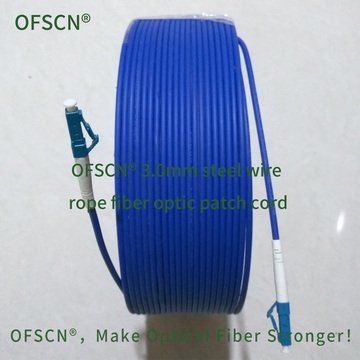
3. OFSCN® 3.0mm Steel Wire Rope Fiber Optic Patch Cord
If your ODF cabinet is located in an environment with vibration, high tensile forces, or harsh industrial conditions, this heavy-duty patch cord with a stainless steel wire physical protection structure provides high tensile strength ( \ge 1200\text{N}) and compression resistance for the connector exit.