Does a pigtail have a connector on only one end? What is its function in a junction box?
I. Does a Pigtail Only Have a Connector on One End?
Yes. From the standard optical engineering definitions and product classifications, a Fiber Optic Pigtail indeed has a fiber optic connector (Connector) installed on only one end, while the other end is a bare fiber (Bare Fiber).
- Distinction from a Fiber Optic Patch Cord:
- Fiber Optic Patch Cord: Equipped with fiber optic connectors on both ends, used for direct active connections between equipment and active components, or between equipment and patch panels.
- Fiber Optic Pigtail: Features a connector on one end and bare fiber on the other. It is primarily used for the termination of fiber optic transmission links.
- Field Engineering Practice: In actual cabling projects, technicians often cut a “fiber optic patch cord” with connectors on both ends in the middle, directly yielding two “fiber optic pigtails” of the same specifications for use.
II. What is the Role of a Pigtail in a Junction Box (Fiber Optic Terminal Box/Distribution Box)?
A fiber optic junction box or terminal box serves as the final termination and distribution hub after an optical cable enters a building. Fiber optic pigtails play a crucial role as physical and optical connection bridges at this point:
-
Fiber Splicing and Signal Transition
Outdoor optical cables typically have very high mechanical strength, are passive, have a thick sheath, and contain multiple bare fibers internally. They cannot be directly inserted into optical switches, optical terminals, or optoelectronic conversion equipment. Within the junction box, engineers use a fusion splicer to perform high-precision splicing (Fusion Splicing) between the bare fiber core of the optical cable and the bare fiber end of the pigtail, achieving a smooth transition of the signal from the backbone optical cable to the terminal patch connection. -
Mechanical Protection and Bend Radius Assurance
The spliced point of a bare fiber is extremely fragile. The junction box contains a Splice Tray. After the spliced point is covered with a heat-shrink protective sleeve, it is securely fixed in the splice tray. The pigtail’s own tight buffer tube or protective outer jacket (typically in 0.9\text{ mm}, 2.0\text{ mm}, or 3.0\text{ mm} specifications) provides necessary physical protection and allows the fiber to be safely coiled within the limited space of the junction box, ensuring the bend radius meets specifications and avoiding microbending or macrobending losses (Bending Loss). -
Provision of Standard Physical Interface
The end of the pigtail with the connector is inserted and secured into a fiber optic adapter (Adapter/Coupler) on the panel of the junction box. Through this method, the otherwise non-pluggable optical cable core is converted into a standard, repeatedly pluggable interface on the exterior of the box (such as FC, SC, LC, ST, etc.). Subsequently, a regular dual-headed patch cord can be used to easily connect the optical signal to the final host device or demodulation instrument.
Related OFSCN® Products and Technical References
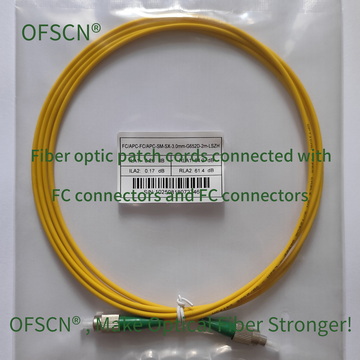
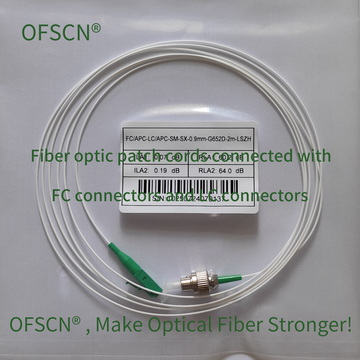
OFSCN®'s high-performance fiber optic patch cords are manufactured by Beijing Dacheng Yongsheng Technology Co., Ltd. and can be flexibly customized into single-ended (pigtail form) or double-ended (patch cord form) configurations according to engineering needs.
For example, the OFSCN® Standard Fiber Patch Cord uses standard single-mode fiber and offers excellent mechanical and optical physical specifications:
- Key Parameter Specifications:
- Fiber Type: Default selection is standard OFSCN® G.652D Optical Fiber (core diameter 9\ \mu\text{m}, cladding diameter 125\ \mu\text{m}, coating diameter 255\ \mu\text{m}).
- Outer Diameter and Structure: Default diameter is 3.0\text{ mm}, with options for 2.0\text{ mm} or 0.9\text{ mm} micro-structure customizable for coiling within high-density junction boxes.
- Connector Specifications: Supports multiple standardized interfaces such as FC/APC, FC/PC, SC, LC, ST, etc. (with a default 10\text{cm} protective sleeve after the connector).
- Operating Temperature Range: -20^\circ\text{C} to 50^\circ\text{C} .
Using high-quality OFSCN® pigtails for termination with backbone optical fibers can effectively reduce Return Loss and suppress Insertion Loss, ensuring long-term, stable physical connections for the fiber optic transmission system.