How is the quality of pre-made jumpers from the factory better than those made on-site?
In optical communication and optical sensing engineering, “Factory Pre-terminated Patch Cord” and “Field Termination” have fundamental differences in physical performance, microscopic geometric structure, long-term reliability, and production environment.
Here is a scientific analysis of the quality differences between the two from the perspective of optical engineering and manufacturing processes:
I. Core Quality Differences and Physical Mechanisms
1. Microscopic Endface Geometry Control
The Return Loss (RL) and Insertion Loss (IL) of fiber optic connectors are highly dependent on the 3D geometric parameters of the connector ferrule endface.
- Pre-terminated Patch Cords: In a controlled factory environment, specialized multi-station precision grinding machines are used, along with a series of coarse and fine grinding discs and slurries made of diamond, silicon dioxide, etc., for strict programmed grinding. Their Apex Offset, Fiber Undercut/Protrusion, and Radius of Curvature can all be strictly controlled and 100% physically profiled using 3D interferometers for inspection.
- Field Termination: Typically relies on manual grinding by field technicians. Manual grinding cannot guarantee uniform force application and symmetry of the grinding trajectory, leading to excessive apex offset and overly large fiber depressions. This not only prevents physical contact (PC) between fiber cores, significantly increasing return loss (generating severe Fresnel reflections), but also may cause wear or scratches to high-value equipment adapters during mating and unmating.
2. Epoxy Curing Process and Long-Term Reliability
The fixation of the optical fiber within the ceramic ferrule depends on adhesives, and the quality of their curing determines the patch cord’s resistance to tensile stress and temperature changes.
- Pre-terminated Patch Cords: Factories use industrial-grade epoxy resins (such as the commonly used 353ND adhesive) and perform strict temperature and time program control in specialized high-temperature curing ovens. The cured adhesive has completely cross-linked molecules, exhibiting very high thermal stability and glass transition temperature (T_g), with almost no expansion or contraction at extremely high or low temperatures.
- Field Termination: To shorten construction time, field terminations often use fast-curing adhesives or anaerobic adhesives (which do not require heating). These types of adhesives have low cross-linking density and poorer tensile strength and weather resistance. When exposed to alternating temperatures or high humidity environments, the adhesive can age, release stress, and cause fiber pullback or even breakage within the ferrule.
3. Production Cleanliness and Micro-scratches
The fiber core (the core of a single-mode fiber is only about 9µm) is very small and extremely susceptible to damage from dust and impurities.
- Pre-terminated Patch Cords: The entire process of stripping, cleaving, bonding, and grinding is carried out in a Class 10,000 or Class 100,000 cleanroom, where airborne suspended particles are strictly filtered.
- Field Termination: Construction sites inevitably have a large amount of dust, metal shavings, and construction debris. Even micron-sized dust particles entering the microscopic pores of the ferrule can cause difficulty in fiber insertion or create localized internal stress. Furthermore, dust on the grinding pad during grinding acts as an abrasive, leaving fatal deep micro-scratches on the fiber endface (especially in the core area).
4. Factory Testing and Traceability (Comprehensive Quality Control)
- Pre-terminated Patch Cords: 100% of products undergo insertion loss and return loss testing, and endface magnified video inspection before leaving the factory. High-end industrial-grade patch cords also undergo full 3D geometric profile scanning.
- Field Termination: On-site testing is usually limited by the accuracy of portable instruments. Field technicians mostly use a simple red light pen (VFL) to confirm continuity or a basic optical power meter to test insertion loss. Return loss, which reflects hidden internal damage and reflection performance of the connector, is extremely difficult to accurately evaluate in the field.
II. OFSCN® Industrial Grade Pre-terminated Patch Cord Products
For high reliability requirements in stringent environments such as scientific research, industry, and power sensing, OFSCN® offers a range of special fiber optic patch cords that are completely pre-terminated in the factory and rigorously 100% tested:
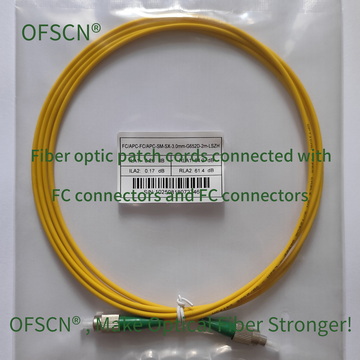
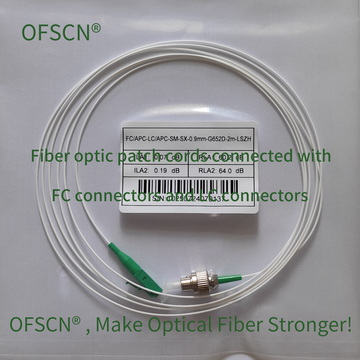
1. OFSCN® Standard Fiber Patch Cord
Standard pre-terminated fiber optic patch cords suitable for routine scientific experiments, communication rooms, and precision instruments. Features low insertion loss and extremely high repeat mating consistency.
-
Standard Image Links:
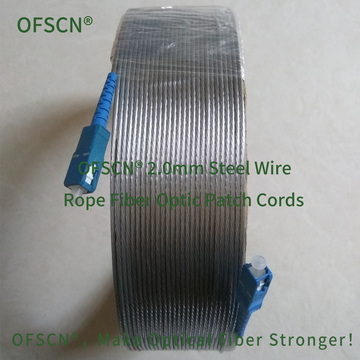
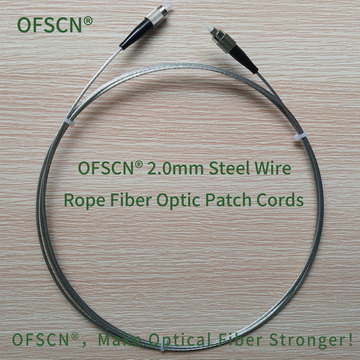
2. OFSCN® 2.0mm Steel Wire Rope Fiber Optic Patch Cord
Features an all-metal protective structure (0.6mm galvanized steel wire stranded structure, 1.0mm seamless stainless steel tube) suitable for blind-zone-free protection patch cords in various harsh industrial field applications, ensuring robust protection through integrated factory pre-termination.
-
Standard Image Links:

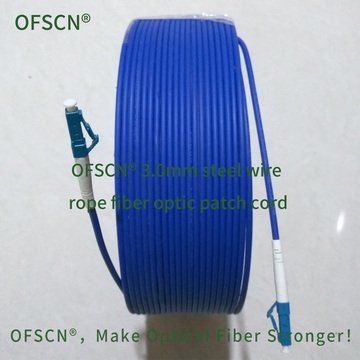
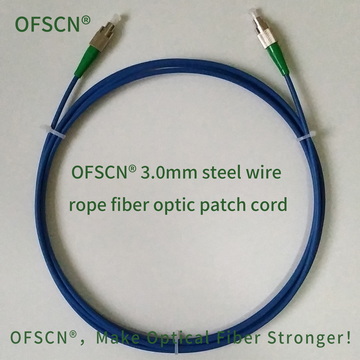
3. OFSCN® 3.0mm Steel Wire Rope Fiber Optic Patch Cord
Heavy-duty industrial grade pre-terminated patch cords with extremely high tensile and compressive strength, exceeding 1200N tensile strength and 200MPa compressive strength, maintaining excellent optical performance under dragging and heavy pressure in harsh construction site environments.
-
Standard Image Links:

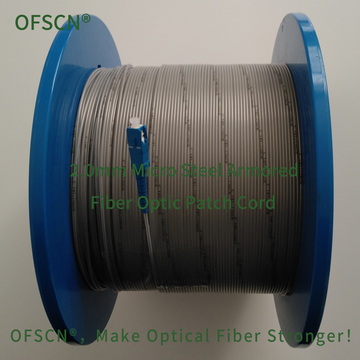
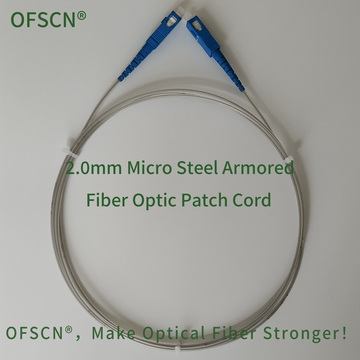
4. OFSCN® 2.0mm Micro Steel Armored Fiber Optic Patch Cord
Micro-armored stainless steel seamless steel tube reinforced patch cord, providing strong physical protection while maintaining a relatively small outer diameter (2.0mm).
-
Standard Image Links:

If the test environment involves extreme temperature gradients, OFSCN® also offers specialized metallized connectors and high-temperature curing processes in the factory, providing:
- OFSCN® 300℃ Fiber Optic Patch Cord (Polyimide Fiber Pre-terminated)
- OFSCN® 700℃ Fiber Optic Patch Cord (Gold-Plated Fiber Pre-terminated)
For details and classification of other OFSCN® fiber optic patch cord products, please refer to the OFSCN® Official Fiber Optic Patch Cord Classification Page.