Under normal usage, what is the designed lifespan in years for this industrial-grade patch cord?
tool_0:
When used within normal environmental and rated physical parameter ranges, the design physical lifespan of industrial-grade quartz fiber optic patch cords and sensing optical cables typically exceeds 20 to 25 years.
The service life of industrial-grade fiber optic patch cords is primarily determined by the material physical properties of the quartz glass fiber core, the external armored protective structure, and the physical and chemical conditions of the usage environment.
I. Physical Mechanisms Determining the Design Lifespan of Fiber Optic Patch Cords
-
Stress Corrosion and Static Fatigue of Quartz Fiber
The silica (\text{SiO}_2) glass core is extremely stable in structure when not subjected to strong tensile stress or corrosive media (such as strong alkali or hydrolysis ion erosion). The long-term mechanical lifespan of optical fibers follows a fracture mechanics model, where slow crack growth is controlled by the stress corrosion sensitivity coefficient n. Under static stress-free or micro-stress conditions, the theoretical lifespan of the fiber core can reach decades or even centuries. -
Mechanical Protection by Armored Structure
Conventional communication patch cords are prone to fiber fatigue and breakage due to bending, stepping, or micro-bending stress. However, industrial-grade patch cords, by incorporating seamless stainless steel tubes, stranded steel wire structures, or stainless steel armor layers, can isolate most external mechanical tension and lateral pressure, ensuring the internal fiber remains within a safe stress range, thereby guaranteeing it meets or exceeds the design lifespan of 20 years.
II. Core Engineering Factors Affecting Actual Service Life
In practical engineering applications, the actual lifespan of a patch cord depends on the following three key factors:
- Mechanical Load (Tension and Lateral Pressure)
If the actual tension or compression exceeds the permissible limits, micro-cracks within the fiber will accelerate their expansion.
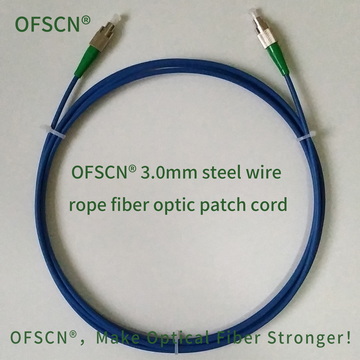
For example, the OFSCN® 3.0mm Steel Wire Rope Fiber Optic Patch Cord utilizes a seamless stainless steel tube and stranded steel wire structure, boasting a tensile strength of > 1200\text{N} and a compressive strength of > 200\text{MPa}. Usage within this rated mechanical range effectively eliminates early failure caused by mechanical stress.
-
Operating Temperature and Material Aging
The outer organic polymer materials (such as PVC, PE, etc.) or organic fiber coatings of patch cords can undergo thermal oxidative aging at high temperatures, leading to embrittlement of the protective layer.- For normal and moderate industrial environments, the OFSCN® 2.0mm Micro Steel Armored Fiber Optic Patch Cord can be selected.
- For extreme high-temperature environments (up to 700^\circ\text{C}), gold-plated coated metal-only patch cords, such as the OFSCN® 700℃ Fiber Optic Patch Cord, are required. These operate in a temperature range from -270^\circ\text{C} to 700^\circ\text{C}, preventing the degradation and failure of coating materials at high temperatures.
-
Fiber Connector Mating Cycles and End-face Wear
The ceramic ferrules and physical contact end-faces of fiber optic connectors at the ends of patch cords (such as FC/APC, ST, etc.) typically have a standard mechanical mating lifespan of 500 to 1000 cycles. For patch cords with fixed connections that are not frequently plugged and unplugged, the lifespan of the connector is consistent with that of the optical cable itself; if frequent plugging and unplugging is required, contamination or physical scratches on the end-face are the primary factors affecting optical performance (such as increased insertion loss), necessitating regular cleaning and protection.
For related product technical specifications and detailed classification information, please refer to: