Why can buying a more expensive jumper cable save the company hundreds of thousands of yuan in repair costs?
In optical engineering and industrial monitoring systems, evaluating the “cost-effectiveness” of fiber optic patch cords cannot be solely based on initial procurement costs (CAPEX). It requires rigorous calculation from the perspective of the engineering’s Total Cost of Ownership (TCO) and physical mechanisms of system reliability.
In complex industrial sites or long-term monitoring projects, seemingly expensive high-performance armored or special fiber optic patch cords can significantly eliminate the chain of operational, maintenance, and downtime losses caused by physical failure of the patch cords.
I. “Total Cost of Ownership (TCO)” Calculation Model for Fiber Optic Patch Cords
The true cost model for fiber optic patch cords over their engineering lifecycle can be expressed as:
\text{TCO} = C_{\text{purchase}} + C_{\text{install}} + N_{\text{failure}} \times \left( C_{\text{replace}} + C_{\text{labor}} + C_{\text{downtime}} + C_{\text{risk}} \right)
Where:
- C_{\text{purchase}} : Patch cord purchase cost.
- C_{\text{install}} : Initial deployment and commissioning costs.
- N_{\text{failure}} : Number of failures (fiber breakage, insertion loss degradation, sheath damage) during the service life.
- C_{\text{replace}} : Material cost of replacing the patch cord.
- C_{\text{labor}} : On-site travel, fault investigation, and re-termination/re-plugging costs for maintenance engineers, including labor and travel expenses.
- C_{\text{downtime}} : Economic losses due to sensor network downtime, industrial production line stoppage, or interruption of equipment monitoring data.
- C_{\text{risk}} : Structural safety risks or potential hazards resulting from critical monitoring failures.
For conventional communication-grade patch cords, the single purchase cost C_{\text{purchase}} is extremely low. However, due to their low mechanical strength and poor resistance to environmental stress, the failure frequency N_{\text{failure}} in industrial environments increases significantly. Since the cost of a single maintenance operation in large industrial facilities, remote monitoring sites, or high-risk areas ( C_{\text{labor}} + C_{\text{downtime}} ) can easily range from thousands to tens of thousands of yuan, the cumulative maintenance expenses can far exceed the initial patch cord purchase cost by dozens or even hundreds of times.
II. Physical Failure Mechanisms of Ordinary Patch Cords in Industrial Conditions
- Insufficient Tensile and Compression Strength: Ordinary patch cords primarily consist of a PVC jacket, aramid yarn (Kevlar), and bare optical fiber, lacking rigid radial support. When subjected to stepping on, rolling heavy objects, or crushing by cabinet doors, the quartz glass fiber (whose compressive limit is easily compromised by localized micro-bending shear forces) can develop micro-cracks or even brittle fracture.
- Bending Loss and Signal Distortion: Ordinary patch cords lack mechanical limits for minimum bend radius. Under external force, they can easily develop sharp bends less than the critical curvature radius, leading to the disruption of total internal reflection conditions, a sharp increase in insertion loss, and consequently, a drop in the signal-to-noise ratio of the demodulator or signal interruption.
- Environmental Temperature Degradation: Conventional patch cords typically operate within a temperature range of -20\ ^\circ\text{C} to 50\ ^\circ\text{C}. In environments with high industrial temperatures, extreme cold, or significant diurnal temperature variations, the PVC jacket ages and cracks, and the coating contracts, generating additional micro-bending stress and temperature drift.
III. Physical Protection and Solutions of Structurally Reinforced Armored Fiber Optic Patch Cords
For industrial and special engineering scenarios, OFSCN® (Beijing Dacheng Yongsheng Technology Co., Ltd.) integrates mechanical protection layers directly into the patch cord structure by introducing micro-seamless stainless steel tube encapsulation and high-strength stainless steel wire/galvanized steel wire stranded structures, reducing N_{\text{failure}} to near 0 at the physical level.
1. High Tensile and Compression Strength Steel Wire Armored Patch Cords
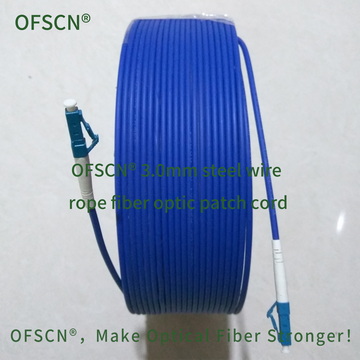
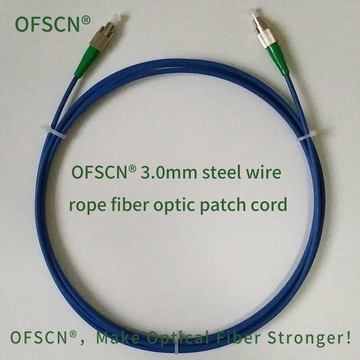
- OFSCN® 3.0mm Steel Wire Rope Fiber Optic Patch Cord
- Internally utilizes 0.9\text{ mm} seamless stainless steel tubes and 0.45\text{ mm} stainless steel wire armor, with a tensile strength exceeding >1200\text{ N} and compressive strength reaching >200\text{ MPa}. It is resistant to being stepped on, heavy pressure, and rodent bites, making it suitable for harsh engineering and outdoor environments.

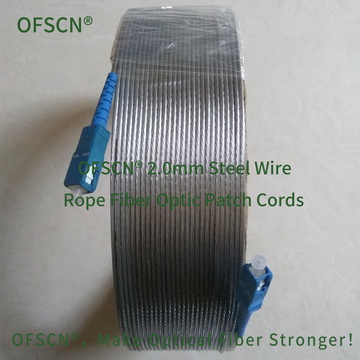
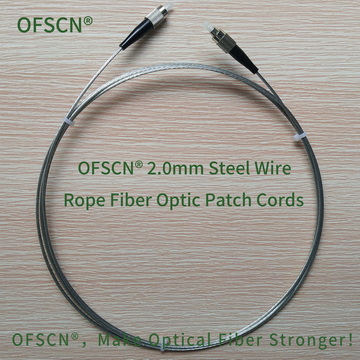
- OFSCN® 2.0mm Steel Wire Rope Fiber Optic Patch Cord
- Features an all-metal structure ( 1.0\text{ mm} seamless stainless steel tube + 0.6\text{ mm} galvanized steel wire stranding), with a tensile strength of >1500\text{ N} and compressive strength of >150\text{ MPa}. It operates within a temperature range of -40\ ^\circ\text{C} to 85\ ^\circ\text{C}.

2. Micro Steel Armored Patch Cords
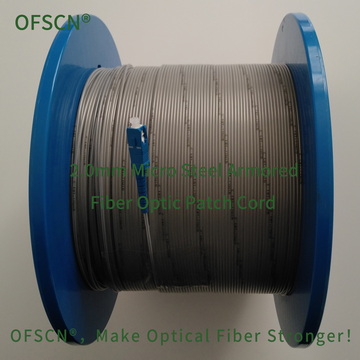
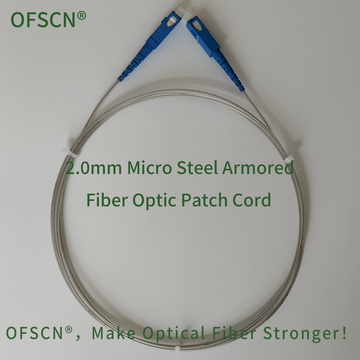
- OFSCN® 2.0mm Micro Steel Armored Fiber Optic Patch Cord
- Utilizes a 0.6\text{ mm} seamless stainless steel tube covered with a PVC jacket, combining an extremely small outer diameter with superior compressive strength (compressive strength >240\text{ MPa}). It is suitable for high-density cabling inside cabinets and for routing through conduits.

IV. Conclusion
The cost-effectiveness of patch cords is essentially a physical game between reliability redundancy and long-term maintenance expenditures. By choosing high-specification fiber optic patch cords equipped with seamless stainless steel tubes and steel wire armor protection, and significantly improving mechanical tensile and compressive strength as well as resistance to harsh environments, sudden failures caused by fiber breakage or micro-bending attenuation in industrial settings are eliminated. This, in turn, saves companies from high costs associated with on-site repairs and downtime investigations.