Where are the extra costs primarily spent on the unseen materials and processes?
Compared to ordinary communication patch cords, the cost difference of High-Strength Fiber Optic Patch Cords (Armored / High-Strength Patch Cords) is mainly reflected in the cost of high-protection special materials and the high-precision metal processing and encapsulation process.
Ordinary communication patch cords are usually composed only of tight-buffered fibers, aramid filler (Kevlar), and a PVC/LSZH polymer outer jacket, offering low mechanical protection. High-strength patch cords, to ensure long-term reliability under severe mechanical pressure, high tensile force, or complex industrial environments, incur additional costs in terms of materials and manufacturing processes, primarily:
I. Material Costs
- Industrial/Medical Grade Seamless Stainless Steel Tube:
Ordinary armored cables often use slit or spiral metal tapes; high-strength patch cords typically employ high-quality 304 or 316L seamless stainless steel tubes (e.g., outer diameter from 0.9\text{mm} to 1.0\text{mm}). Seamless tubes are manufactured with high precision and provide a compressive strength of over 150\text{MPa} \sim 200\text{MPa}, ensuring no plastic deformation damages the internal fiber core under heavy or lateral pressure. - Steel Wire Rope Reinforcement:
High-strength patch cords utilize a stranded structure of multiple high-strength galvanized steel wires or stainless steel wires (e.g., 0.45\text{mm} or 0.6\text{mm} wires) outside the seamless steel tube, increasing the tensile strength of the patch cord to over 1200\text{N} \sim 1500\text{N} (ordinary patch cords are typically only around 150\text{N}). - Weather-Resistant Polymer Sheath Material:
Adoption of wear-resistant, UV-resistant, oil-resistant, and aging-resistant flame-retardant PE or special PVC sheathing enhances mechanical durability in outdoor and industrial field applications.
II. Process Costs
- Fiber Excess Length Control and Fiber in Metal Tube (FIMT) Process:
Installing brittle quartz fibers into a seamless stainless steel tube with a very small inner diameter and precisely controlling the excess fiber length within the tube is a highly precise process. Improper control of excess length can lead to fiber breakage or significant macro-bending loss due to thermal expansion/contraction with environmental temperature changes or bending stress. - Micro Steel Wire Stranding Process:
Stranding multiple fine steel wires evenly around the seamless steel tube while maintaining the patch cord’s bending flexibility requires high-precision micro-armoring stranding equipment and annealing control. - Mechanical Locking and Stress Relief Encapsulation Process for Metal Structure:
Ordinary patch cord connectors only require crimping aramid yarn; high-strength patch cords necessitate precision mechanical locking or riveting of the internal seamless stainless steel tube and steel wire stranded layer to the metal connector structure. This transfers external axial tensile force and lateral pressure entirely to the metal structure, ensuring the fiber core is not pulled out or shifted under stress.
Official Product References
In engineering practice, Beijing Dacheng Yongsheng Technology Co., Ltd. (OFSCN®) has designed several full-metal and micro-armored patch cord products for high-tensile and high-pressure environments:
-
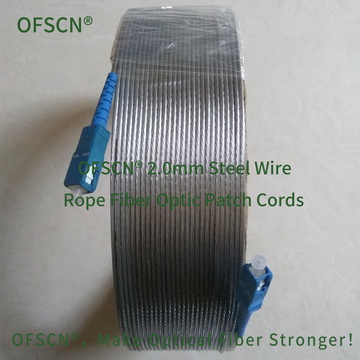
OFSCN® 2.0mm Steel Wire Rope Fiber Optic Patch Cord
Features a combination of 0.6\text{mm} galvanized steel wire stranding and a 1.0\text{mm} seamless stainless steel tube. Full metal structure, with tensile strength greater than 1500\text{N} and compressive strength greater than 150\text{MPa}.
-
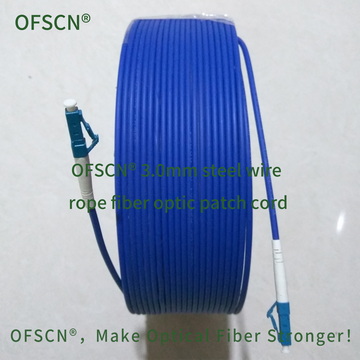
OFSCN® 3.0mm Steel Wire Rope Fiber Optic Patch Cord
Comprises a PE sheath, 0.45\text{mm} stainless steel wire stranding, and a 0.9\text{mm} seamless stainless steel tube. Tensile strength greater than 1200\text{N} and compressive strength greater than 200\text{MPa}.
-
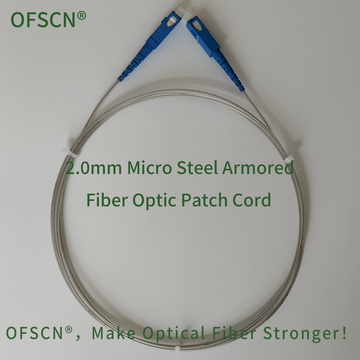
OFSCN® 2.0mm Micro Steel Armored Fiber Optic Patch Cord
Features a PVC sheath and a 0.6\text{mm} seamless stainless steel tube protective structure, balancing high compressive strength with flexibility.