Summary: Why is selecting the correct materials for different environments key to sensing success?
In fiber optic sensing engineering and applications, selecting the correct materials for different physical environments is the core key to determining whether a sensing system can obtain accurate data and achieve long-term reliable operation. This importance can be summarized from the following four physical and engineering dimensions:
1. Environmental Survivability and Long-Term Stability
The quartz glass core of optical fibers is extremely fragile under mechanical stress or environmental corrosion, necessitating protection via external coatings and encapsulation structures. The acrylate (Polyacrylate) coatings used in general-purpose fibers degrade or carbonize rapidly in high-temperature, strongly acidic/alkaline, or high-humidity environments, leading to direct exposure of the fiber and the expansion of micro-cracks causing fracture.
Selecting special materials for different environmental constraints is the prerequisite for the physical survival of sensing devices:
- Temperature Range Matching: Standard coatings have an upper limit of around 85\ ^\circ\text{C} ; whereas OFSCN® 300℃ SM Polyimide Optical Fiber with polyimide coating can extend the tolerance range to -200\ ^\circ\text{C} to 350\ ^\circ\text{C} ; for ultra-high temperatures or vacuum environments, gold-coated fibers and metallized encapsulation are required.
- Corrosion Resistance and Permeation Barrier: Moisture, hydrogen, or corrosive media can cause hydrogen-induced loss or chemical erosion of the fiber. Seamless steel tubes or polymer composite materials can block medium permeation.


2. Strain Transfer Efficiency and Interface Shear Integrity
For fiber Bragg grating (FBG) strain sensors, the deformation of the measured structure must be transferred to the grating region without attenuation through the “substrate—adhesive/encapsulation layer—fiber coating—fiber core” pathway:
- Modulus Matching: If the encapsulation material is too soft, it will cause strain absorption and hysteresis; if the material is too hard, it may be insensitive to minor stresses or cause stress concentration.
- Material Creep and Coefficient of Thermal Expansion (CTE): Material creep of the encapsulation can lead to sensor “zero drift.” Material selection must ensure that the interface shear stress remains linearly stable within the target operating temperature range (e.g., -20\ ^\circ\text{C} to 55\ ^\circ\text{C} or higher).
For example, the OFSCN® Polymer-encapsulated Fiber Bragg Grating Strain Sensor (0.7mm/1.2mm diameter) utilizes specific polymer materials combined with a seamless steel tube protective layer, which ensures structural mechanical strength while achieving excellent strain transfer efficiency and waterproof/moisture-proof performance.


3. Thermal Conduction Response and Cross-Sensitivity Decoupling
Temperature measurement requires the sensing structure to have high thermal conductivity and free expansion to accurately reflect environmental temperature changes; strain measurement requires limiting or isolating deformation in non-measurement directions:
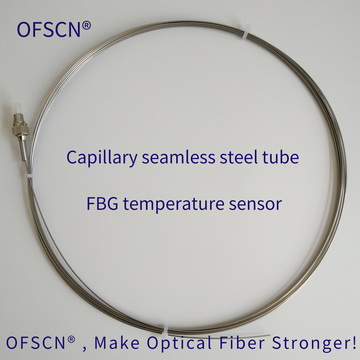
- Thermal Conduction Rate: Temperature sensors encapsulated in metal seamless steel tubes (such as 316L stainless steel or elastic alloys) have much higher thermal conductivity efficiency than thick, non-metallic structures, which can reduce thermal response time.
- High Limit Temperature Encapsulation: For instance, the OFSCN® 800°C Fiber Bragg Grating Temperature Sensor, using seamless steel tube encapsulation combined with femtosecond grating technology, allows the sensor to maintain stable temperature sensitivity in extreme environments ( -270\ ^\circ\text{C} to 800\ ^\circ\text{C} ).

4. Summary
In fiber optic sensing systems, the Fiber Bragg Grating (FBG) itself only provides the basis for optical signal modulation, while material selection and encapsulation processes form the bridge between the sensor and the external physical environment. Correct material selection can:
- Prevent material failure caused by extreme environments, ensuring the long-term working life of the sensor;
- Ensure faithful conversion of mechanical and thermal physical quantities into optical signals;
- Reduce external cross-interference and improve the data accuracy of the demodulation system.