Is it like putting a “coat of armor” on the raster? What is the main function of this layer?
In fiber optic sensing engineering, the analogy of “packaging” as giving the grating a layer of “armor” is very apt.
From the perspective of physical concepts and optical engineering principles, bare Fiber Bragg Gratings (FBGs) are inherently fragile. Taking standard silica (fused silica glass) optical fiber as an example, its bare fiber diameter is only 125\ \mu\text{m}. Even after a primary recoating (such as acrylate recoating, increasing the diameter to 255\ \mu\text{m}; or polyimide recoating, with a diameter of approximately 155\ \mu\text{m}), it is still unable to be directly used in complex industrial environments or harsh outdoor conditions, and is prone to physical fracture or performance degradation due to lateral shear, compression, excessive bending, or chemical corrosion.
Therefore, sensor-level packaging utilizes structural materials such as metals (e.g., seamless stainless steel tubes, alloy tubes), high-performance polymers, and ceramics to securely and scientifically protect the Fiber Bragg Grating. This layer of “armor” primarily serves four core functions:
1. Mechanical Protection and Load Resistance (Fracture Prevention)
Although silica glass has high tensile strength, it is extremely susceptible to shear forces, lateral compression, and sharp impacts. The packaging shell, acting as a mechanical load-bearing component, effectively disperses and resists external mechanical shocks, compressions, and bending stresses, ensuring that the delicate fiber core inside remains undamaged.
2. Efficient Transfer of Physical Quantities and Precise Coupling (Key to Sensing Performance)
Packaging is not merely about blocking external forces; it also bears the crucial responsibility of being a “signal transmission medium”:
- For Strain/Stress Sensors: The packaging material and adhesive must possess high shear stiffness to ensure that the minute tensile or compressive deformation (strain) of the external substrate is transmitted losslessly and without hysteresis through the interface layer to the fiber core, causing a linear drift in the Bragg reflection wavelength $$\lambda_B$$.
- For Temperature Sensors: The packaging needs to minimize the interference of mechanical stress. It is designed as “stress-free packaging” to ensure that the reflection wavelength drift (formula: $$\Delta \lambda_B = \lambda_B ( \alpha + \xi ) \Delta T$$, where $$\alpha$$ is the coefficient of thermal expansion of the fiber and $$\xi$$ is the thermo-optic coefficient) is solely caused by temperature changes, thus achieving temperature-strain decoupling. Additionally, the packaging material must have excellent thermal conductivity to shorten the response time.
3. Environmental Isolation and Chemical Protection (Corrosion and Moisture Resistance)
In long-term humid, high-temperature environments, or in the presence of specific chemical agents (such as strong acids, alkalis, crude oil, etc.), the interaction between water molecules and silica molecules can accelerate the expansion of micro-cracks (i.e., stress corrosion cracking). Packaging with stainless steel, special polymers, or high-performance polymers provides excellent water and gas tightness, preventing corrosion and extending the service life of the sensor.
4. Engineering Installation and Positioning Interface
Bare FBGs themselves cannot be welded, bolted, or clamped with high strength. Through sensor packaging, standardized physical interfaces can be provided for on-site engineering installation. For example, threaded structures, welding bases, mounting clamp slots, or special roughened surfaces conducive to epoxy adhesion can be designed, greatly enhancing engineering feasibility.
Beijing Dacheng Yongsheng Technology Co., Ltd. (OFSCN®) Typical Packaging Examples
To adapt to different sensing scenarios, Beijing Dacheng Yongsheng Technology Co., Ltd. (OFSCN®) has designed various representative packaging forms, which are strictly distinguished in terms of performance and housing structure:
A. Bare Grating / Grating String (Primary coating only, suitable for user self-packaging or embedded experiments)
Example: OFSCN® Polyacrylate Fiber Bragg Gratings / FBG Strings (Bare)
This product comes with only the basic acrylate recoating protection, maintaining the original delicate diameter. It is primarily used for users to perform composite material embedding or customized packaging.

B. Polymer and Metal Double Encapsulation (For precision strain sensing, ensuring accurate strain coupling)
Example: OFSCN® Polymer-encapsulated Fiber Bragg Grating Strain Sensor (0.7mm/1.2mm diameter)
This sensor uses a polymer material for inner layer protection and conduction, with an outer layer of seamless steel tubing to enhance overall rigidity and moisture resistance. While maintaining an ultra-fine outer diameter, it provides a stable measurement range of up to $$\ge 3000\mu\varepsilon$$.

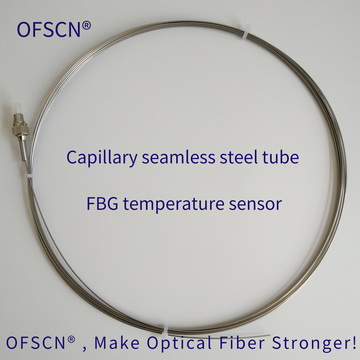
C. Seamless Steel Tube Thermal Conduction Packaging (For high-temperature, high-pressure temperature measurement)
Example: OFSCN® 500°C Fiber Bragg Grating Temperature Sensor
This sensor is typically encapsulated with single or multiple layers of nested stainless steel seamless steel tubes. It can operate stably within an extreme temperature range of -200^\circ\text{C} to 500^\circ\text{C}, providing rapid thermal response while withstanding external pressure.
In summary: FBG packaging is not a simple “skinning” process; it is a critical physical and mechanical design that imbues fragile optical fibers with industrial survivability and transforms them into “fiber optic sensors” capable of precise operation and resistance to environmental interference.