Summary: Rigorous testing ensures every patch cord can survive extreme environments.
From the perspectives of fiber physics, interface mechanics, and harsh environment reliability engineering, a detailed and rigorous factory test report is not just a set of data records, but physical evidence that quantifies the microstructural integrity, thermodynamic stability, and long-term service life of fiber optic patch cords.
Under extreme conditions (such as cryogenic temperatures of -270°C, ultra-high temperatures of +300°C to +700°C, strong impacts, heavy side pressure, and tensile stress), the failure mechanisms of fiber optic components typically originate from initial defects at the micrometer or even nanometer scale. Rigorous factory testing and detailed test reports ensure the high reliability and survival capability of patch cords in extreme environments through the following core engineering dimensions:
I. Fiber Failure Mechanisms and Test Significance in Extreme Environments
-
Screening of Subcritical Microcrack Propagation (Stress Corrosion)
- Physical Mechanism: The silica (SiO2) glass network, in the presence of microscopic surface defects and tensile stress, is highly susceptible to attack by water molecules or corrosive media in the environment. This leads to chemical bond breakage, triggering subcritical propagation of Griffith microcracks, and ultimately causing catastrophic brittle fracture of the fiber at stresses far below its theoretical strength.
- Test Assurance: Mechanical tensile proof testing during the factory process applies a defined load threshold, which can physically eliminate samples with critical crack defects before shipment, ensuring that the retained fibers possess the minimum theoretical fracture lifetime.
-
Thermal Expansion Mismatch (CTE Mismatch) and Thermally Induced Microbending Loss
- Physical Mechanism: The coefficient of thermal expansion (α ≈ 5.5 × 10⁻⁷ /°C) of quartz fiber differs by nearly two orders of magnitude from that of the outer stainless steel ferrule (α ≈ 1.6 × 10⁻⁵ /°C) and the cured adhesive. During extreme temperature cycling, interfacial shear stress can cause the fiber core to buckle or compress, leading to mode distortion and severe additional microbending loss.
- Test Assurance: Optical performance monitoring during temperature ramps and cycles across the entire temperature range (e.g., -40°C to +85°C or wider) verifies the rationality of the internal microstructural stress relief design, ensuring that the additional loss under extreme temperature variations meets specifications.
II. Key Parameters and Physical Metrics Covered in Detailed Test Reports
OFSCN®'s standardized detailed test reports provide traceable quantitative records for each key parameter:
-
End-face Interferometry Geometry
- Radius of Curvature (ROC): Ensures appropriate elastic deformation during physical contact (PC/APC) of the connector end-face, eliminating air gaps without damaging the ceramic ferrule.
- Apex Offset: Controls the deviation of the polishing apex from the fiber core center, preventing core misalignment or insufficient contact pressure during mating.
- Fiber Height / Undercut / Protrusion: Nanometer-level precise measurement of the fiber’s protrusion or recession relative to the ceramic ferrule end-face, preventing expansion of end-face air gaps caused by thermal cycling.
-
Optical Transmission and Reflection Parameters (IL & RL)
- Insertion Loss (IL): Comprehensive testing of intrinsic loss across various wavelengths (e.g., 1310 nm, 1550 nm), reflecting core alignment accuracy and internal microbending status.
- Return Loss (RL): Verifies the angle and flatness of the fiber end-face polishing, preventing Fresnel reflection from returning to the light source or causing interference noise in demodulation equipment.
-
Mechanical Load Resistance Parameter Verification
- Detailed tests cover the tensile limit load (e.g., > 1200 N to > 1500 N) and crushing limit (e.g., > 150 MPa to > 240 MPa) of the armored tube. This ensures that the mechanical deformation remains within the elastic limit when external forces are applied, preventing direct transfer of external loads to the internal fibers.
III. Representative Patch Cord Products for Extreme Environment Applications
For different extreme physical environments, Dacheng Yongsheng (OFSCN®) offers a range of fiber optic patch cords, from high mechanical strength to ultra-wide operating temperatures:
1. High Tensile and Compression Resistance Series (Steel Wire Rope Structure Armoring)
Utilizing a composite encapsulation of micro-seamless stainless steel tubes and steel wire stranding, these provide high tensile and side-pressure resistance:
-
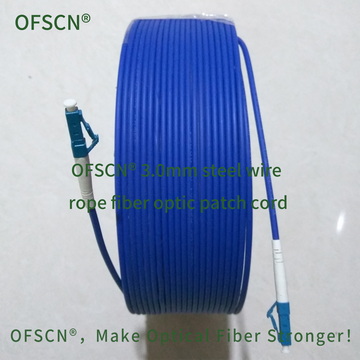
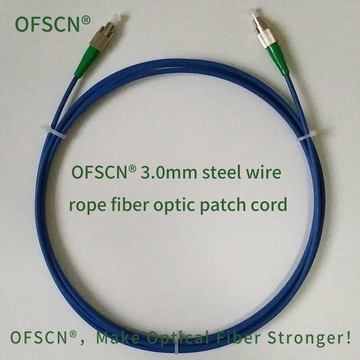
OFSCN® 3.0mm Steel Wire Rope Fiber Optic Patch Cord (Tensile strength > 1200 N, compressive strength > 200 MPa, operating temperature -40°C to +75°C)
-
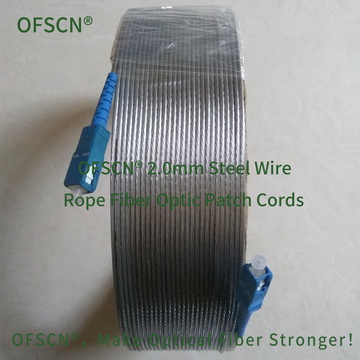
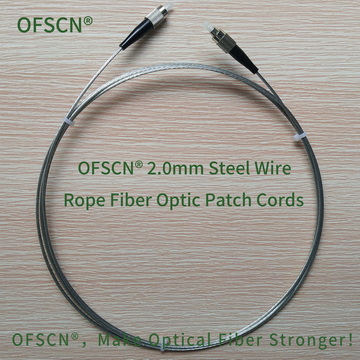
OFSCN® 2.0mm Steel Wire Rope Fiber Optic Patch Cord (All-metal structure, operating temperature -40°C to +85°C)


2. Extreme Temperature Range Patch Cord Series
Employing temperature-resistant polyimide-coated fibers or metal-plated fibers, encapsulated with seamless stainless steel protective tubes:
-
OFSCN® 300℃ Fiber Optic Patch Cord (Withstands ultra-wide operating temperature range from -270°C to +300°C)
-
OFSCN® 700℃ Fiber Optic Patch Cord (Withstands extreme low to high temperatures from -270°C to +700°C, based on gold-plated fiber)



More patch cord specifications can be found at: