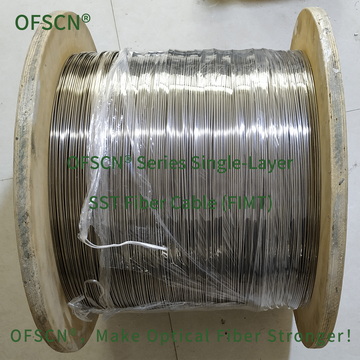
From the deep sea to outer space, from extreme cold to scorching heat, how does OFSCN® solve all challenges with a single optical fiber?
In specialty sensing engineering, the physical characteristics of the silica (\text{SiO}_2) based optical fiber itself, such as immunity to electromagnetic interference, intrinsic safety, low transmission loss, and minuscule geometric dimensions, are beneficial. However, unprotected bare fused silica fibers are prone to failure due to the propagation of mechanical microcracks, thermal decomposition of coatings, hydrostatic pressure infiltration, or Hydrogen Darkening.
OFSCN® addresses extreme operating conditions encountered in deep sea, outer space, cryogenic, and high-temperature environments by constructing a comprehensive engineering physics barrier, ranging from specialty fiber material modification to micron-level seamless metallization encapsulation:
I. Physical Resilience in Extreme Temperature Domains (-270\ ^\circ\text{C} to 800\ ^\circ\text{C})
The dual acrylate coatings commonly used in standard communication fibers are typically limited to an operating temperature range of -40\ ^\circ\text{C} \sim 85\ ^\circ\text{C}. Outside this range, polymers become brittle due to glass transition or undergo thermal degradation and carbonization at high temperatures, leading to the fracture of the fused silica fiber or a sharp decline in optical signal quality.
-
High-Temperature and Cryogenic Coating Technologies
- Polyimide-Coated Fibers: OFSCN® employs temperature-resistant polyimide coatings, enabling stable long-term operation between -200\ ^\circ\text{C} \sim 350\ ^\circ\text{C} (with short-term resistance down to -270\ ^\circ\text{C} cryogenic temperatures). This effectively overcomes the brittle failure of polymers in liquid helium and liquid nitrogen temperature ranges.
- Metal-Plated (Gold-Plated) Fibers: For extreme high temperatures ranging from 350\ ^\circ\text{C} \sim 700\ ^\circ\text{C}/800\ ^\circ\text{C}, a continuous gold metallization layer replaces organic polymers, eliminating the risk of volatile gas generation from organic decomposition.
-
Decoupling of Thermal Stress and Athermal Packaging
In temperature sensors, OFSCN® utilizes an internal slip-release stress decoupling structure. The Fiber Bragg Grating (FBG) or distributed sensing element is housed within a micro-protective tube. This design eliminates additional axial mechanical stress caused by the mismatch in the Coefficient of Thermal Expansion (CTE) between the fiber and the metal casing, ensuring that the Bragg wavelength shift (\Delta\lambda_B) purely reflects the thermo-optic effect and the thermal expansion of the fiber material:\Delta\lambda_B = \lambda_B (\alpha_\Lambda + \xi) \Delta TWhere \alpha_\Lambda is the thermal expansion coefficient of the fiber, and \xi is the thermo-optic coefficient.
II. High-Pressure, Fluid Infiltration, and Corrosion Barrier for Deep Sea and Deep Well Environments
In deep-sea high hydrostatic pressure environments or in oil and gas downhole applications thousands of meters deep, ambient pressures can reach tens to hundreds of megapascals ( \text{MPa} ). These conditions are often accompanied by corrosive seawater, saturated water vapor, or highly concentrated corrosive media such as \text{H}_2\text{S}/\text{CO}_2.
- Seamless Metal Microtube Encapsulation (Seamless Metal Tube)
OFSCN® eschews seamed, welded tubes or plastic sheaths, opting for compact encapsulation within cold-drawn seamless tubes made of 304, 316L stainless steel, or even 825 corrosion-resistant high-temperature nickel-based alloy. The wall thickness is designed based on high-pressure physical mechanics (typical outer diameters range from 0.5\ \text{mm} \sim 6.35\ \text{mm}). The seamless tube eliminates stress concentrations and potential leak points at welded seams, enabling resistance to high hydrostatic pressure and the axial tensile and shear forces encountered in complex downhole operations. - Multi-Layer Physical Nested Barrier
For ultra-deep wells and extremely harsh conditions, OFSCN® employs a staged buffering structure with dual-layer and triple-layer seamless metal tubes. The outer tube handles pressure bearing, wear resistance, and fluid scouring, while the inner microtube provides a clean optical channel and buffers radial strain transmission, completely isolating external chemical ions and high-pressure fluids from infiltrating the fiber core.
III. High Cleanliness and Zero Outgassing Design for Space and Vacuum Environments
Aerospace and vacuum payload applications impose stringent limits on material outgassing rates. Organic adhesives or protective sheath materials can easily volatilize organic compounds under ultra-high vacuum (UHV) and severe thermal cycling conditions, potentially contaminating optical lenses or compromising payload integrity.
- OFSCN®'s micro-scale all-metal encapsulated sensors and high-temperature fibers eliminate volatile low-molecular-weight polymers, ensuring excellent vacuum compatibility.
- The structural outer diameter can be miniaturized to 0.5\ \text{mm} \sim 0.9\ \text{mm}. Within the weight and geometric constraints of spacecraft, these solutions offer lightweight temperature/strain monitoring capabilities that withstand severe thermal variations and high vibration loads.
IV. Related OFSCN® Core Specialty Product Specifications
To address the aforementioned extreme conditions, OFSCN® has established corresponding standardized product series:
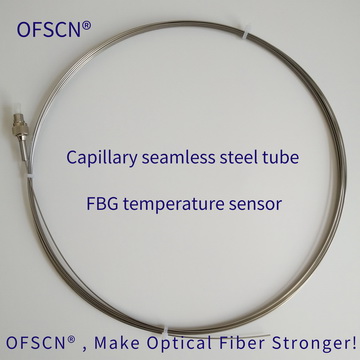
1. Extreme High-Temperature and Ultra-Wide Temperature Range Fiber Bragg Grating Temperature Sensors
- Product: OFSCN® 800°C Fiber Bragg Grating Temperature Sensor
- Operating Temperature: -270\ ^\circ\text{C} \sim 800\ ^\circ\text{C}
- Encapsulation Structure: Single or multi-layer seamless alloy steel tube encapsulation, with a default outer diameter \le 1.1\ \text{mm} (minimum customizable outer diameter of 0.5\ \text{mm})

2. Downhole High-Pressure, High-Temperature Specialty Fiber Optic Cables
- Product: OFSCN® Double-Layer High-Temperature Downhole Fiber Optic Cable
- Product: OFSCN® Triple-Layer Downhole High-Temperature Fiber Optic Cable
- Encapsulation Structure: Dual or triple-layer nested seamless stainless steel/825 alloy tubes (e.g., outer layer diameter 6.35\ \text{mm}, wall thickness 0.9\ \text{mm}), incorporating single-mode or multi-mode temperature-resistant fibers, resistant to high temperature, high pressure, and complex chemical media corrosion.


3. Extreme Environment Distributed Temperature and Strain Sensors
- Product: OFSCN® 700°C Distributed Fiber Temperature Sensor
- Product: OFSCN® 700°C OFDR Micro All-Metal Strain Sensor
- Operating Temperature Range: -270\ ^\circ\text{C} \sim 700\ ^\circ\text{C}. Utilizes 0.6\ \text{mm} \sim 0.9\ \text{mm} metal tube protection combined with gold-plated single-mode fiber, suitable for OFDR, Raman DTS, or Brillouin scattering systems.