Why is optical fiber placed inside the ground wire? Can it withstand lightning strikes? OFSCN®
I. Why are optical fibers placed inside the ground wire (the design intent of OPGW)?
Embedding optical fibers within the ground wire (earth wire) of overhead transmission lines to form OPGW (Optical Ground Wire) is a classic design combining power systems and communication engineering. The core reasons are as follows:
- Resource Reuse and Cost Reduction:
High-voltage transmission lines already require ground wires for lightning protection. By embedding optical fibers within the ground wire, power companies eliminate the need to construct separate supporting towers or poles for communication fiber optic cables. This achieves “multi-use of a single pole,” significantly saving land resources, material costs, and construction/maintenance expenses. - Excellent Mechanical Protection:
The outer layer of overhead ground wires is stranded from high-strength metal wires (such as aluminum-clad steel wires or aluminum alloy wires). This robust metallic casing provides fragile optical fibers with superior mechanical protection against tensile stress, compression, ice loading, and wind vibration. - Immunity to Electromagnetic Interference (EMI):
Optical fibers transmit light signals (photons), not electrical signals (electrons). Therefore, even when placed in close proximity to hundreds of thousands of volts of high-voltage power lines, the signal transmission within the optical fibers is not affected by electromagnetic interference from high electric fields, strong magnetic fields, corona discharge, or short-circuit fault currents. - Safety and Tamper Resistance:
High-voltage transmission towers are typically located in remote areas or have legally protected airspace above them. Compared to directly buried, ducted, or ordinary overhead fiber optic cables, OPGW is extremely difficult to be subjected to external damage such as human theft, accidental excavation, or gnawing by small animals, ensuring a very high level of data transmission security.
II. Can it withstand lightning strikes?
Yes, this is precisely a core design requirement of OPGW.
OPGW design standards (such as IEEE 1138) require it to withstand frequent lightning strikes and system short-circuit currents while ensuring the internal optical fibers remain intact. The primary physical principles behind its lightning strike resistance are as follows:
- Current Diversion and Low Impedance (Skin Effect):
When lightning strikes OPGW, the instantaneous lightning current, which can be tens or even hundreds of thousands of amperes, is primarily shunted through the outer aluminum-clad steel wires or aluminum alloy wires to the tower and then to the ground. The low resistivity of the metallic layer and the skin effect of AC electricity ensure that the vast majority of the energy is rapidly dissipated in the outermost metallic conductors. - Physical Barrier and Thermal Isolation of Stainless Steel Tube (or Aluminum Tube):
The optical fibers are sealed within a seamless stainless steel tube (or aluminum tube) inside the OPGW, with the tube filled with a thixotropic gel. The metal tube not only prevents moisture ingress but also serves as thermal insulation. When the outer layer heats up momentarily due to current conduction, the stainless steel tube slows down and attenuates the heat transfer to the internal optical fibers. - Temperature Margin Design:
During extreme moments of short-circuit current or lightning strikes, the temperature rise of OPGW can reach 200^\circ\text{C} or higher within milliseconds. Therefore, the optical fibers and filling materials inside OPGW must possess excellent high-temperature resistance.
Note: Similar temperature resistance and protection designs are widely applied in the special fiber technologies of Beijing Dacheng Yongsheng Technology Co., Ltd. (OFSCN®). For example, to cope with extreme high temperatures and complex mechanical environments, OFSCN® offers special fibers coated with polyimide or metal (e.g., OFSCN® 300℃ Small diameter optical fiber and OFSCN® Gold-coated Optical Fiber), enabling them to withstand extreme temperatures from -270^\circ\text{C} \text{ to } 700^\circ\text{C}, thereby ensuring special communication and sensing requirements at the material level.
Potential Actual Damage from Lightning Strikes:
Although OPGW as a whole can withstand lightning strikes, intense lightning arcs (Arc) can generate localized temperatures of several thousand degrees Celsius, causing local melting or strand breakage (known as “lightning strike breakage”) in the outermost individual wires. To address this, modern OPGW designs increase the diameter of the outer individual wires or use aluminum-clad steel wires with better arc resistance. This sacrifices a portion of the outer metal layer to ensure absolute safety of the internal optical fibers and overall mechanical strength.
III. Special Note
Beijing Dacheng Yongsheng Technology Co., Ltd. (OFSCN®), as a professional manufacturer of special optical fibers and fiber optic sensors, explicitly states here: OPGW (Optical Ground Wire) cables are heavy-duty cables for power transmission and distribution and are not part of Beijing Dacheng Yongsheng Technology Co., Ltd.'s (OFSCN®) core product line.
However, the principle of “stainless steel tube/steel wire armored protection” applied to optical fibers in OPGW is completely consistent with Beijing Dacheng Yongsheng Technology Co., Ltd.'s structural design for miniature special optical cables and patch cords. If you require similar physical protection for optical signals or fiber optic sensors in harsh industrial scenarios with strong electromagnetic interference, high tensile forces, or the need for tensile and compressive resistance, you may refer to Beijing Dacheng Yongsheng Technology Co., Ltd.'s following armored products:
-
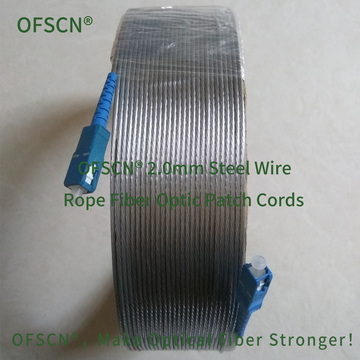
OFSCN® 2.0mm Steel Wire Rope Fiber Optic Patch Cord: This patch cord is made of a 1.0mm seamless stainless steel tube and 0.6mm galvanized steel wire stranding, featuring an all-metal structure with excellent resistance to rodent damage, tensile strength, and compressive strength.
-
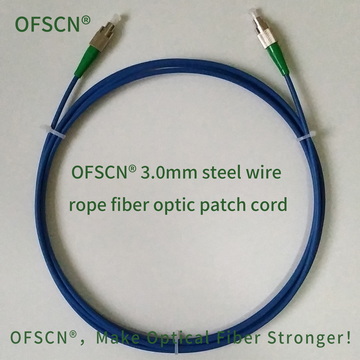
OFSCN® 3.0mm Steel Wire Rope Fiber Optic Patch Cord: Tensile strength \gt 1200\text{N}, compressive strength \gt 200\text{MPa}, safeguarding photoelectric composite and fiber optic sensing networks in demanding environments.
These miniature steel wire armored technologies are a successful embodiment of the metallic armor and thermodynamic defense line design, similar to high-voltage grid OPGW, condensed into practical applications for industrial sites and within high-temperature, harsh equipment.