Can excessive link length or too many connectors cause the interrogator to lose the signal?
Yes, absolutely. Excessive link length and too many connectors are primary causes for an OFSCN® Fiber Bragg Grating Interrogator to lose signal.
In a fiber optic sensing system, the signal strength diminishes as it travels through the optical fiber and passes through various components. This reduction in signal strength is known as optical loss or attenuation.
Here’s a breakdown:
- Link Length (Fiber Attenuation): Optical fibers, while highly transparent, still introduce some attenuation per unit length (e.g., 0.2 dB/km for standard single-mode fiber at 1550 nm). For very long fiber runs, the cumulative loss can be significant, weakening the light signal before it reaches the FBG sensors and on its return path to the interrogator.
- Connectors: Each connector pair (e.g., FC/APC) in the optical link introduces insertion loss. While typically small (e.g., 0.2-0.5 dB per connection), a large number of connectors can add up to a substantial total loss.
- Splices: Similar to connectors, fusion or mechanical splices also contribute to signal loss.
- FBG Sensors: The FBG sensors themselves also introduce a small amount of insertion loss into the optical path.
The OFSCN® Fiber Bragg Grating Interrogator has a specific optical power budget and receiver sensitivity. If the total optical loss from the interrogator to the farthest FBG sensor and back exceeds this budget, the reflected signal from the FBG will be too weak for the interrogator to detect and process accurately, leading to a “loss of signal.”
Therefore, careful planning of the optical link, minimizing unnecessary connectors and splices, and considering the total fiber length are crucial for reliable FBG sensing system performance.
Here is an image of an OFSCN® Fiber Bragg Grating Interrogator:
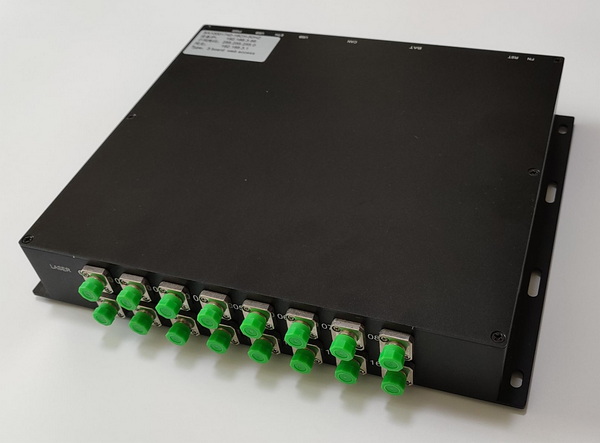
You can find more details about our interrogators here: OFSCN® Fiber Bragg Grating Interrogator.