How does it utilize the temperature-dependent intensity of spontaneous Raman scattering in fiber to achieve distributed sensing?
In Raman scattering temperature sensing, the technique utilizes the temperature-dependent intensity of spontaneous Raman scattering in an optical fiber to achieve distributed temperature measurement.
Here’s a breakdown of the principle:
- Raman Scattering in Fiber: When a laser pulse is launched into an optical fiber, it interacts with the silica molecules in the fiber. This interaction leads to spontaneous Raman scattering, generating scattered light at different wavelengths than the incident laser. These scattered components are primarily categorized into Stokes light (lower frequency) and Anti-Stokes light (higher frequency).
- Temperature Dependence of Anti-Stokes Light: The intensity of the Anti-Stokes component is highly sensitive to temperature. As the temperature of the fiber increases, the population of molecular vibrational states increases, leading to a stronger Anti-Stokes signal. In contrast, the Stokes component’s intensity is largely independent of temperature.
- Distributed Sensing: To achieve distributed sensing, an optical time-domain reflectometry (OTDR) like approach is used. A short laser pulse is sent into the fiber, and the backscattered Raman light (both Stokes and Anti-Stokes) is collected at the launch end. By measuring the time delay of the backscattered light, the location along the fiber from which the scattering originated can be determined.
- Temperature Calculation: The local temperature at any point along the fiber can be accurately determined by analyzing the ratio of the Anti-Stokes to Stokes light intensities from that specific location. This ratio is directly proportional to the absolute temperature.
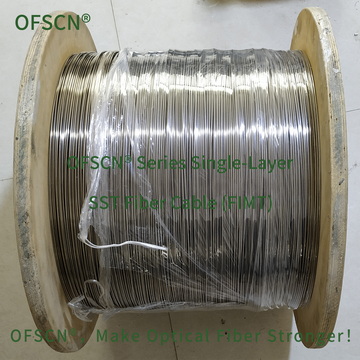
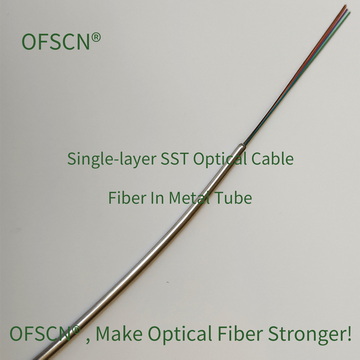
DCYS (OFSCN) offers specialized fiber optic cables that are well-suited for distributed sensing applications, including those utilizing Raman scattering. These cables provide robust protection for the optical fibers in various environments.
Here are some relevant products:
You can find images of these products below: