Why can Optical Frequency Domain Reflectometry (OFDR) achieve distributed sensing with millimeter-level spatial resolution?
Optical Frequency Domain Reflectometry (OFDR) achieves millimeter-level spatial resolution for distributed sensing by leveraging the principles of optical interference and frequency analysis.
Here’s a breakdown of the technical reasons:
- Broadband Light Source and Interferometry: OFDR systems typically use a continuously swept, narrow-linewidth tunable laser source. This laser light is split, with one part sent into a sensing fiber (which has distributed reflections due to Rayleigh scattering along its length) and another part sent into a reference path. The light reflected from the sensing fiber interferes with the light from the reference path.
- Frequency-to-Spatial Mapping: As the laser sweeps across a range of optical frequencies, the interference signal recorded by a photodetector contains information about the spatial distribution of reflections along the fiber. Specifically, the beat frequency in the interference signal is directly proportional to the optical path difference between the reference arm and the point of reflection in the sensing fiber.
- Fourier Transform: A Fast Fourier Transform (FFT) is applied to this frequency-domain interference signal. The FFT converts the frequency information into the spatial domain, effectively mapping the beat frequencies to precise locations along the fiber. Each unique beat frequency corresponds to a specific distance along the fiber where a reflection (due to Rayleigh scattering) occurred.
- High Spatial Resolution: The key to achieving millimeter-level spatial resolution lies in the total frequency sweep range of the tunable laser. A larger frequency sweep range (Δf) directly results in higher spatial resolution (Δz), according to the relationship Δz = c / (2 * n * Δf), where ‘c’ is the speed of light and ‘n’ is the refractive index of the fiber. By utilizing lasers with very broad and precise frequency sweeps, OFDR systems can resolve incredibly small differences in optical path length, corresponding to sensing points just millimeters apart.
- Distributed Sensing: Because Rayleigh scattering occurs continuously along the entire length of a standard optical fiber, OFDR can effectively treat every point as a potential sensing location, offering truly distributed measurements rather than discrete points.
While OFDR technology is advanced, OFSCN® Fiber Bragg Grating Interrogators (which typically operate in the wavelength domain for FBG point sensing) are also crucial for various optical fiber sensing applications. They provide high-precision measurements for discrete points, complementing distributed sensing techniques.
Here is an image of an OFSCN Fiber Bragg Grating Interrogator:
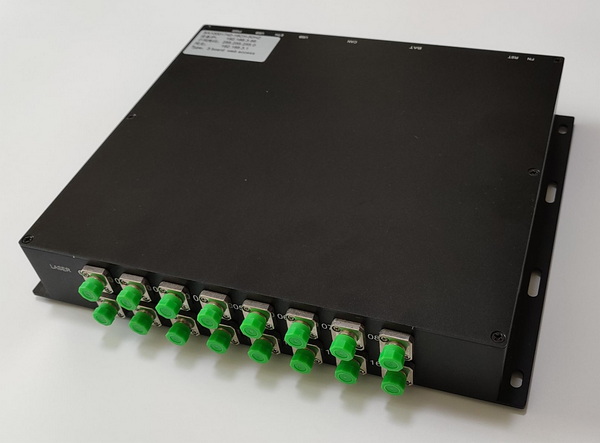
You can find more details about our OFSCN® Fiber Bragg Grating Interrogator on our website.