Why does an increase in temperature cause the reflected wavelength to shift toward longer wavelengths? What roles do the thermo-expansion effect and thermo-optic effect play?
An increase in temperature causes the reflected wavelength of a Fiber Bragg Grating (FBG) to shift toward longer wavelengths (redshift) due to the combined influence of two primary effects: the thermo-expansion effect and the thermo-optic effect.
-
Thermo-expansion effect: When the temperature of an optical fiber increases, the fiber material (typically silica) undergoes thermal expansion. This expansion leads to an increase in the grating period (Λ) of the FBG. According to the Bragg condition (λB = 2 * neff * Λ), where λB is the Bragg wavelength and neff is the effective refractive index, an increase in Λ directly results in a shift of the Bragg wavelength to longer values.
-
Thermo-optic effect: The refractive index of the fiber core material is also sensitive to temperature changes. As the temperature rises, the effective refractive index (neff) of the fiber core increases. This change in refractive index is more significant than the change due to thermal expansion. An increase in neff, according to the Bragg condition, also causes the Bragg wavelength to shift to longer wavelengths.
Both effects work synergistically, causing the FBG’s reflected wavelength to shift to longer wavelengths as the temperature increases. The thermo-optic effect generally has a larger contribution to the overall wavelength shift than the thermo-expansion effect for typical silica optical fibers.
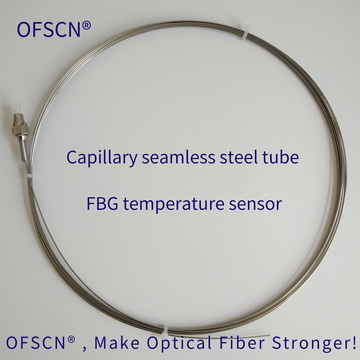
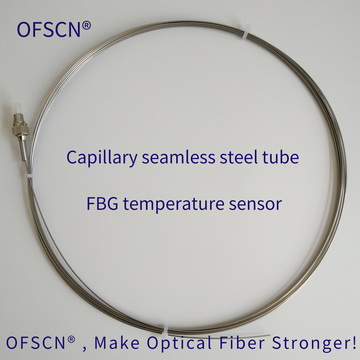
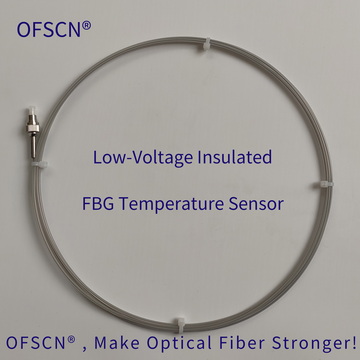
OFSCN® offers a range of Fiber Bragg Grating Temperature Sensors designed for various temperature environments, utilizing these principles for precise temperature measurement:
-
OFSCN® 100°C Fiber Bragg Grating Temperature Sensor
You can find more details here: OFSCN® 100°C Fiber Bragg Grating Temperature Sensor -
OFSCN® 300°C Fiber Bragg Grating Temperature Sensor
You can find more details here: OFSCN® 300°C Fiber Bragg Grating Temperature Sensor -
OFSCN® 500°C Fiber Bragg Grating Temperature Sensor
You can find more details here: OFSCN® 500°C Fiber Bragg Grating Temperature Sensor -
OFSCN® Ultra-low temperature FBG temperature sensor
You can find more details here: OFSCN® Ultra-low temperature FBG temperature sensor