Why is it the most versatile packaging material? What are its corrosion resistance limits?
316L stainless steel is a highly versatile packaging material for Fiber Bragg Grating (FBG) sensors due to its excellent balance of properties. It offers superior corrosion resistance, especially against chlorides, compared to 304 stainless steel, thanks to the addition of molybdenum. This makes it suitable for a broad array of applications in various corrosive environments and across a significant temperature range. Its good mechanical strength and weldability also contribute to its widespread use in robust FBG sensor packaging.
Regarding its corrosion resistance limits, while 316L stainless steel provides enhanced resistance, it is not entirely immune. Its performance can be challenged in extremely aggressive chemical environments, such as highly concentrated acids or very high chloride concentrations, especially when combined with elevated temperatures and pressures. In such severe conditions, pitting or crevice corrosion can occur. For applications involving extremely high temperatures or exceptionally harsh corrosive media, materials like Inconel 825 alloy are typically considered for even greater resilience.
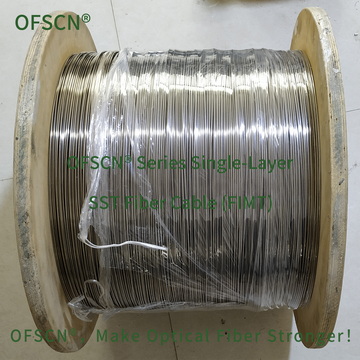
For example, our OFSCN® 300°C Seamless Steel Tube Fiber Cable utilizes 316L stainless steel as the default encapsulation material, demonstrating its capability for high-temperature applications up to 300°C in demanding environments.
An example of a seamless steel tube fiber cable packaging is shown below:
You can find more details on our range of seamless steel tube fiber cables on our website.