If fiber optic cables and high-voltage cables are bundled together, will the signals produce noise or garbled data?
Conclusion: When transmitting optical signals, fiber optics are completely immune to electromagnetic interference (EMI), meaning optical signals themselves will never produce noise or garbled data.
However, in practical engineering deployments (especially when directly bundled with high-voltage cables), while the optical signal remains unaffected, several critical physical and engineering factors require rigorous consideration. Here is a detailed analysis of the technical principles and engineering precautions:
I. Physical Principles: Why Are Optical Signals Immune to EMI?
- Fundamental Difference Between Photons and Electrons:
Traditional cable communication relies on the flow of electrons in a conductor (like copper wire) to transmit electrical signals. Because electrons carry charge, strong electromagnetic fields (the intense electric and alternating magnetic fields generated around high-voltage cables) directly exert Lorentz force on the electrons, causing superimposed noise (manifesting as static or garbled data) in the signal.
Fiber optic communication utilizes total internal reflection of photons (light waves) within the silica glass core for transmission. Photons do not carry charge and do not couple with external electromagnetic fields. - Absolute Electromagnetic Isolation:
Due to the aforementioned physical characteristics, even if bare optical fibers are tightly bundled with tens of thousands of volts of high-voltage cables, the strong electromagnetic fields generated by the high-voltage cables cannot alter the physical state of the photons. Therefore, the optical signal within the fiber optic maintains absolute signal integrity during transmission.
II. Three Major Potential Hazards and Countermeasures in Actual Engineering Applications
Despite the immunity of optical signals to interference, the following engineering risks must be properly addressed when optical fibers (or fiber optic sensors) are bundled with high-voltage cables:
-
Metallic Components Inside the Optical Cable (Risk of Induced Voltage and Electrical Breakdown):
To increase tensile strength or prevent rodent damage, many general-purpose optical cables (or armored optical fibers encased in stainless steel seamless pipes) contain metallic strength members or stainless steel armor layers.- Hazard: If an optical cable containing metallic structures is directly bundled with high-voltage cables, the strong electromagnetic field of the high-voltage cable can induce high voltages or eddy currents in the metallic layers within the optical cable. This not only compromises the external insulation of the high-voltage cable itself but can also cause arcing during lightning strikes or overloads, leading to insulation breakdown or equipment damage.
- Countermeasure: In high-voltage or strong electromagnetic environments, All-Dielectric/Non-metallic structured optical cables or specially insulated sensors must be used.
-
Heating of High-Voltage Cables (Risk of Thermal Overload):
High-voltage cables generate significant Joule heat during full-load or overload operation.- Hazard: The outer jackets of ordinary communication optical cables (such as Polyethylene PE, Polyvinyl Chloride PVC) typically have a temperature resistance limit of only -40^\circ\text{C} to 75^\circ\text{C}. If the temperature at the bundling point exceeds its tolerance limit, the jacket may melt or age, causing micro-bending losses in the optical fibers due to mechanical pressure, leading to severe signal attenuation or even interruption.
- Countermeasure: Special high-temperature resistant optical fibers (such as polyimide or special acrylate fibers resistant to 120^\circ\text{C}, 200^\circ\text{C}, 300^\circ\text{C} and above) should be selected based on the actual operating temperature of the cables.
-
Electromagnetic Shielding of Optical Equipment:
- Hazard: While the optical fiber itself is immune to electromagnetic interference, the active devices connected at both ends of the fiber – such as optical transceivers, Fiber Bragg Grating (FBG) demodulators, etc. – are all highly sensitive microelectronic systems. If these terminal devices are too close to high-voltage cables and lack shielding, electromagnetic noise can still be injected into the electronic components, resulting in data corruption during digital processing.
- Countermeasure: Receiving and modulation equipment must be equipped with good electromagnetic shielding (e.g., installed in metal enclosures) and ensure proper system grounding.
III. OFSCN® Professional Solutions for Strong Electromagnetic and High-Voltage Environments
For temperature monitoring needs in harsh industrial environments such as high-voltage, strong electromagnetic fields, and high temperatures, Dacheng Yongsheng (OFSCN®) offers specialized non-metallic, high-insulation, and high-temperature resistant sensor products:
-
OFSCN® Ceramic-encapsulated Fiber Bragg Grating Temperature Sensor:
This product utilizes high-insulation ceramic encapsulation technology, completely eliminating the risk of metal conductors in high electromagnetic environments. It features excellent electrical insulation performance and extremely high temperature resistance, specifically designed for high-precision temperature measurement in strong electromagnetic interference and high-voltage live environments.
-
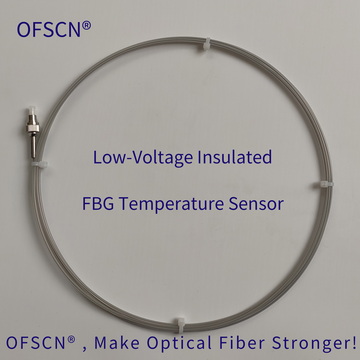
OFSCN® 150 Low-Voltage Insulated Fiber Bragg Grating Temperature Sensor:
This low-voltage insulated Fiber Bragg Grating temperature sensor is designed for temperature measurement scenarios requiring electrical isolation, such as medium and low-voltage high-current applications. It effectively eliminates electromagnetic noise near power lines, ensuring pure and accurate reading of the temperature wavelength signal.