Why does the grating signal remain stable under strong magnetic fields and high-voltage lines?
In extreme physical environments such as strong magnetic fields, high-voltage power transmission lines, and intense electromagnetic interference (EMI), the core reasons for the extremely high signal stability of Fiber Bragg Grating (FBG) sensors can be scientifically explained from two dimensions: Medium Physical Characteristics and Signal Modulation Mechanisms:
1. Physical Nature of Transmission Medium and Carrier (Insulation and Non-Electromagnetic Response)
- Non-Conductive and Non-Magnetic Medium: Traditional electrical sensors rely on metal wires to transmit electrical signals. In proximity to strong magnetic fields or high-voltage lines, according to Maxwell’s electromagnetic field theory, time-varying electromagnetic fields induce electromotive forces and eddy currents in metal wires through electromagnetic induction, introducing strong alternating noise into the signal loop, potentially leading to dielectric breakdown or short circuits. Fiber optic sensors, on the other hand, use high-purity quartz glass ( \text{SiO}_2 ), which is a naturally excellent electrical insulator and non-magnetic medium, neither conductive nor magnetic.
- Weak Interaction Nature of Photons: The signal carriers transmitted within the fiber optic cable are photons, not electrons. Within the framework of classical electrodynamics, photons carry no electric charge and do not directly couple or interact with conventional external alternating electromagnetic fields. This means that under strong magnetic fields and high voltages, the transmission path and phase of light within the fiber are not distorted by electromagnetic interference, thereby eliminating electromagnetic interference at its physical origin.
2. Modulation Mechanism of Wavelength-Encoding
Fiber Bragg Grating (FBG) is an optical device that reflects specific wavelengths through periodic refractive index perturbations. Its sensing mechanism follows the Bragg reflection equation:
\lambda_B = 2 n_{eff} \Lambda
Where:
- \lambda_B is the center wavelength of the Bragg reflected light;
- n_{eff} is the effective refractive index of the fiber core;
- \Lambda is the physical period of the grating.
Changes in external physical quantities (such as temperature or strain) directly alter n_{eff} and \Lambda , consequently causing a shift in the reflected wavelength \lambda_B .
This type of sensor employs wavelength modulation rather than amplitude modulation. In environments with strong electromagnetic interference, electrical sensors are susceptible to attenuation or fluctuations in voltage and current amplitudes. However, the signal integrity of FBG sensors depends solely on the peak wavelength within the reflected spectrum. Even if external interference causes slight fluctuations in light intensity (amplitude noise), the center wavelength value remains constant. The demodulator only needs to identify the peak wavelength to accurately obtain the measurement data, ensuring high signal stability and exceptional robustness.
Packaging Solutions for High-Voltage and Strong Electromagnetic Environments
Although optical fibers themselves are immune to electromagnetic interference, in practical engineering applications, if metal sheaths (such as stainless steel tubes) are used to package the fibers, the metal casing can still generate induced currents under high-voltage and strong magnetic fields, affecting the local electric field distribution and even posing a risk of discharge.
To achieve absolute safety and signal stability in strong electromagnetic and high-voltage environments, a completely non-metallic, insulated packaging design is typically required. For these extreme power and strong electromagnetic monitoring scenarios, Beijing Dacheng Yongsheng Technology Co., Ltd. (OFSCN®) offers the following matching products:
1. OFSCN® Ceramic-encapsulated Fiber Bragg Grating Temperature Sensor
This sensor completely abandons metal casings and utilizes high-temperature ceramics for encapsulation. Ceramics, as inorganic non-metallic materials, possess extremely high dielectric strength and excellent insulation, pressure resistance, and anti-electromagnetic interference properties. They can operate stably over an ultra-wide temperature range of -270 \ ^\circ\text{C} to 800 \ ^\circ\text{C} , making them ideal temperature measurement components for high-electromagnetic-field and high-voltage environments such as generator and transformer windings.


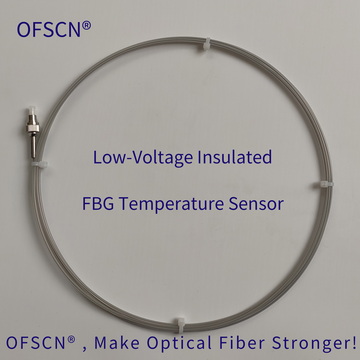
2. OFSCN® 150°C Low-Voltage Insulated Fiber Bragg Grating Temperature Sensor
Specially designed for monitoring low-voltage power transmission, distribution cabinets, and electrical equipment with strong electromagnetic interference. This sensor is protected and encapsulated with special insulating polymer materials, achieving full dielectric discharge protection while offering good thermal conductivity response. Its operating temperature range is from -40 \ ^\circ\text{C} to 150 \ ^\circ\text{C} .