In this environment, what are the special requirements for the sealing materials (such as metal extrusion) of fiber optic ferrules?
In ultra-high vacuum (UHV), typically defined as environments with a pressure below 10^{-7}\text{ Pa} or 10^{-9}\text{ mbar}, the sealing materials and structural design of fiber optic feedthroughs face extremely stringent physical and chemical challenges. Traditional elastomeric seals (such as Viton O-rings) are generally unsuitable for UHV environments due to their high outgassing rates, strong permeability, and lack of resistance to high-temperature bake-outs.
For UHV environments, fiber optic feedthroughs have specific and rigorous requirements for sealing materials and design:
1. Extremely Low Outgassing Rate and Material Inorganicization
In UHV systems, even minute amounts of volatile substances can rapidly degrade the vacuum level.
- External Metal Parts: Materials with ultra-low outgassing rates, such as 316L stainless steel or Oxygen-Free High-Conductivity (OFHC) copper, must be used.
- Fiber Optic Sealing Medium: Organic adhesives like standard epoxy resins are strictly prohibited at the interface between the fiber optic and the metal housing (i.e., within the feedthrough). For UHV applications, special inorganic glass powders with ultra-low outgassing rates must be employed, or metalized fibers can be hermetically sealed using high-purity metal solders (such as indium or gold-tin alloys) via brazing.
2. Bakeability
To remove water molecules and residual gases adsorbed onto the inner walls of vacuum chambers and flange surfaces, UHV systems require high-temperature bake-outs (typically between 150^\circ\text{C} and 250^\circ\text{C}, sometimes even higher) for extended periods, often lasting tens of hours, during the evacuation process.
- Sealing materials and structures must withstand repeated cycles of thermal stress without any mechanical relaxation, creep, or degradation of the seal.
3. Metal Compression Seal and Plastic Deformation Mechanism
For the connection between the flange face and the chamber, UHV systems commonly utilize CF (ConFlat) standard flanges.
- Compression Deformation Principle: Under high pressure from bolts, the steel knife-edge of a CF flange deeply indents a soft OFHC copper gasket.
- Through intense plastic deformation of the metals (i.e., “metal compression”), microscopic surface irregularities are filled, achieving atomic-level intimate contact. This all-metal sealing structure not only withstands extremely high bake-out temperatures but also achieves ultra-low helium leak rates below 1 \times 10^{-10}\ \text{mbar}\cdot\text{l/s}.
4. Physical Structure to Eliminate Virtual Leaks
Any small blind holes within the flange, micro-cracks from incomplete welds, or threaded dead zones can act as gas reservoirs in a UHV environment, leading to “virtual leaks” where slow gas release prevents the vacuum from reaching its target level.
- Metal assemblies of feedthroughs must incorporate through-hole venting designs or be joined using full-penetration vacuum TIG welding or electron beam welding to ensure no trapped cavities remain.
5. Coefficient of Thermal Expansion (CTE) Matching
Quartz fiber’s silica core has a very low CTE (approximately 0.5 \times 10^{-6}/\text{K} ), while stainless steel has a significantly larger CTE (approximately 16 \times 10^{-6}/\text{K} ). Under the substantial stresses generated by high-temperature bake-outs and metal compression, transition expansion alloys (like Kovar) must be used, or stress-relief designs incorporated into welding processes, to prevent fiber fracture at the sealed interface due to shear forces.
OFSCN® Solutions
For fiber optic lead-through and signal transmission requirements in ultra-high vacuum (UHV) and high vacuum environments, OFSCN® provides professional OFSCN® Fiber Optic Vacuum Sealed Flanges.
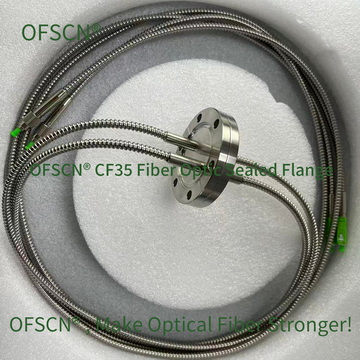
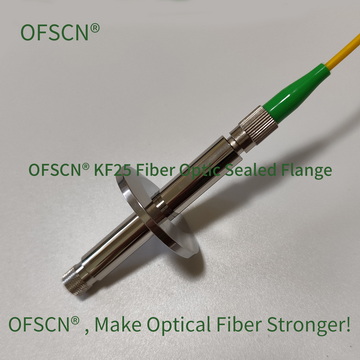
This series of feedthroughs offers the following key technical specifications:
- Vacuum Series: Available in KF and CF series. For UHV requirements, the CF series utilizes all-metal sealing technology, achieving vacuum levels better than 1 \times 10^{-7}\text{ Pa}.
- Temperature Range: Standard products are suitable for room temperature operation, with special customization available for products that can withstand bake-outs up to 250^\circ\text{C}, fully meeting the outgassing and bake-out process requirements of UHV systems.
- Connector Customization: Available in receptacle and plug configurations, supporting single or multi-channel high-density fiber optic feedthroughs to ensure high-quality, low-loss fiber optic signal transmission.