What is the difference between it and a regular PC head? Why is its color usually blue?
“UPC” (Ultra Physical Contact) is a high-precision polishing process standard for fiber optic connector end-faces (Ferrule End-face), evolved from the earlier “PC” (Physical Contact) process.
In fiber optic splicing, to achieve perfect contact between the cores of two optical fibers and transmit optical signals efficiently, the end-face of the connector ferrule (usually made of ceramic or stainless steel) is polished into a microscopic spherical shape. The following are the key physical differences between UPC and standard PC connectors, along with the industry reason why they are typically blue.
I. Differences Between UPC and Standard PC Connectors
-
End-face Polishing Precision and Geometric Morphology
- PC (Physical Contact): Represents an earlier, traditional polishing method. Although its end-face is a microscopic sphere, limited by the processing technology of the time, the control over its spherical geometric parameters was not precise, and the surface roughness was relatively high.
- UPC (Ultra Physical Contact): Builds upon the PC process with more refined and systematic polishing and geometric optimization. This results in extremely strict control over key geometric indicators such as the radius of curvature of the end-face sphere, Apex Offset, and Fiber Undercut. Due to the extremely smooth and perfect end-face, the physical contact between fiber cores is tighter when two fibers are spliced, almost completely eliminating the tiny air gaps between the contact surfaces.
-
Significant Difference in Return Loss (ORL)
Return Loss is a critical physical indicator for measuring the amount of optical signal reflection from the end-face. The larger the absolute value of this metric (i.e., the weaker the reflected optical energy), the better the optical performance of the connector.- PC Connectors: Return Loss is typically around -35\text{ dB} to -40\text{ dB} .
- UPC Connectors: With an ultra-fine polished surface, Return Loss is significantly optimized, with typical values reaching \le -50\text{ dB} (or even \le -55\text{ dB} ), greatly reducing interference from reflected light to light sources, lasers, and precision fiber optic sensors.
-
Stability of Insertion Loss (IL)
Although high-quality PC and UPC interfaces can achieve low insertion loss levels initially (e.g., < 0.3\text{ dB} ), due to the excellent end-face mating of UPC, its signal transmission stability and repeatability perform significantly better than standard PC connectors after repeated insertions/removals and long-term use.
II. Why are UPC Connectors Typically Blue?
The color of fiber optic connectors is not arbitrarily designed but follows the color coding system of international fiber optic communication industry standards (such as TIA-568 standards). This is primarily to enable field engineering technicians to achieve fast, intuitive, and error-free visual identification during installation, testing, and maintenance:
-
Color Standards for Different Polish Types and Fiber Types
- Blue (Blue): Specifically used to represent single-mode (Single-mode) UPC (or PC) connectors. As modern non-angled single-mode connectors have basically been upgraded to UPC level, blue has become the universal identifier for UPC single-mode fiber patch cords or adapters.
- Green (Green): Specifically used to represent Angled Physical Contact (APC) connectors. Their end-face has an 8^\circ angle, providing extremely high Return Loss ( \le -60\text{ dB} ).
- Beige / Aqua / Magenta: Typically represent different generations of multi-mode (Multi-mode) fiber optic connectors (e.g., OM1, OM2, OM3, OM4).
-
Preventing Misoperation Causing Equipment Damage
If an APC (Green) connector with an angled end-face is directly mated with a UPC (Blue) connector with a flat spherical end-face, it will not only result in extremely high insertion loss and optical reflection due to mismatched physical geometry but also cause permanent physical compression wear and mechanical damage to the fiber end-face. The distinct blue and green color design allows technicians to immediately recognize that they cannot be mixed, ensuring the safety of the physical link.
III. Related OFSCN® Professional Product Matching
In applications highly sensitive to reflected light, such as Fiber Bragg Grating (FBG) sensing, fiber optic communication, and precision optical testing systems, high-quality end-face connectors are the cornerstone of stable system operation. OFSCN® offers a full range of high-quality fiber optic patch cords and high-specification fiber optic connectors, supporting customization of various end-face types (including FC, ST, LC, SC interface types) such as PC, UPC, and APC:
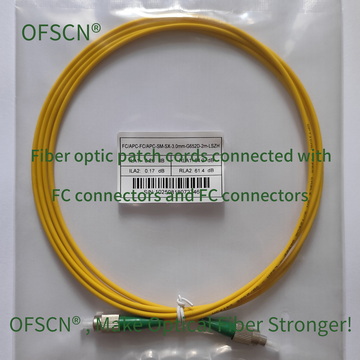
- OFSCN® Standard Fiber Patch Cord: General-purpose high-quality fiber optic patch cords. Connector types (including FC, ST, LC, SC, etc.) can be flexibly customized with PC or APC (including high-precision UPC level polishing process), suitable for conventional laboratory or sensing tests.
- OFSCN® 120℃ Fiber Optic Patch Cord and OFSCN® 120℃ Fiber Optic Connector: Designed specifically for medium-to-high temperature industrial sites, oil and gas, and special applications. Supports customization of various FC and ST connectors, ensuring stable optical physical contact performance even in high-temperature environments.
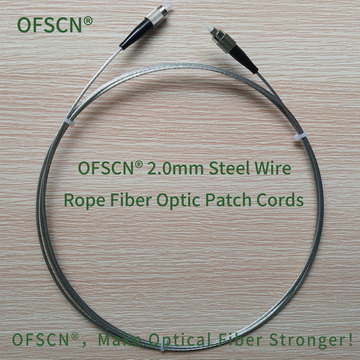
- OFSCN® 2.0mm Steel Wire Rope Fiber Optic Patch Cord: Full metal structure encapsulation, high tensile and compressive strength. Supports customization with high-precision connectors by default.
You can view more detailed encapsulation parameters and technical specifications via the OFSCN® Fiber Optic Patch Cord Product Category Link.
The following are references of standard images for some official products: