How many FBG sensors can a typical 1525nm-1565nm (C-band) range accommodate?
A typical OFSCN® Fiber Bragg Grating Interrogator with a 1525nm-1565nm (C-band) scanning range provides a 40nm usable bandwidth.
When multiplexing FBG sensors on a single optical fiber, the number of sensors that can be accommodated depends on the wavelength spacing allocated for each FBG. This spacing accounts for the FBG’s intrinsic bandwidth, the anticipated wavelength shift due to the measured parameter (e.g., strain or temperature), and a guard band to prevent spectral overlap between adjacent sensors.
Based on practical application and the typical spectral characteristics of OFSCN® FBG sensors, a 40nm interrogator range can generally accommodate approximately 15 FBG sensors per fiber.
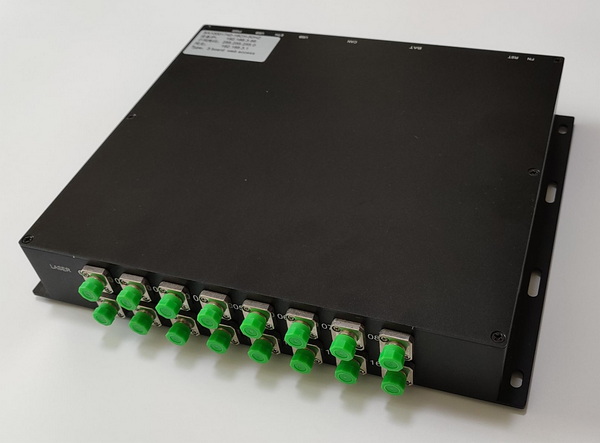
Below is an image of the OFSCN® Fiber Bragg Grating Interrogator:
You can find more detailed technical specifications for our interrogators on our website: OFSCN® Fiber Bragg Grating Interrogator.