How does an interrogator find the center position of a grating by scanning wavelengths?
When an OFSCN® Fiber Bragg Grating Interrogator scans wavelengths to find the center position of a grating, it operates on the principle of detecting the Bragg wavelength reflected by the FBG. Here’s a simplified explanation:
- Broadband Light Source or Tunable Laser: The interrogator emits a light signal. This can be a broadband light source (like an LED or a superluminescent diode) covering a wide spectrum, or a tunable laser that can sweep across a specific range of wavelengths.
- Interaction with FBG: This light travels along the optical fiber to the Fiber Bragg Grating (FBG). The FBG is designed to reflect a very narrow band of wavelengths (the Bragg wavelength) and transmit all other wavelengths.
- Detection of Reflected Light: The interrogator then measures the spectrum of the light reflected back from the FBG.
- Peak Identification: By analyzing this reflected spectrum, the interrogator identifies the precise wavelength at which the maximum reflection occurs. This peak wavelength is the FBG’s Bragg wavelength, which is considered its “center position.”
- Bragg Wavelength Shift: Changes in temperature or strain on the FBG cause its grating period to change, which in turn shifts its Bragg wavelength. The interrogator continuously monitors this shift in the reflected peak to measure the corresponding physical parameter.
Here is an image of the OFSCN® Fiber Bragg Grating Interrogator:
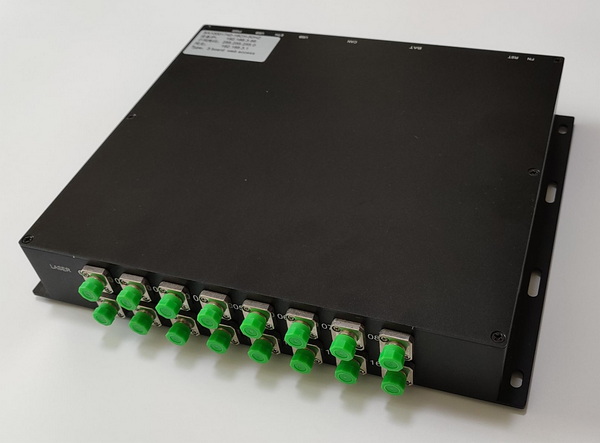
For more details, you can visit the product page:
OFSCN® Fiber Bragg Grating Interrogator