How does it convert optical signals into digital data? What are the differences between Tunable Laser Scanning and CCD Spectrometry?
The OFSCN® Fiber Bragg Grating Interrogator is designed to convert the optical signals from Fiber Bragg Grating (FBG) sensors into digital data, allowing for the measurement of various physical parameters. While the specific internal mechanisms of optical-to-digital conversion and the detailed differences between Tunable Laser Scanning and CCD Spectrometry are complex and involve distinct optical architectures, both methods ultimately aim to precisely detect the Bragg wavelength shift from the FBG, which correlates to the measured physical quantity.
Our OFSCN® Fiber Bragg Grating Interrogator offers robust performance for FBG sensing applications. Its key parameters include:
- Wavelength Range: Default 1525 to 1565nm, or 1528 to 1568nm.
- Channel Count: 4, 8, or 16 channels are available, with 32 channels customizable.
- Data Sampling Frequency: Options for 10Hz, 50Hz, or 100Hz (can be reduced to a minimum of 1Hz via software).
- Software Architecture: Default B/S architecture, supporting C/S architecture and integration with customer systems via TCP, UDP, Modbus, and other protocols.
You can learn more about its functionalities on our website: OFSCN® FBG Interrogator Functions.
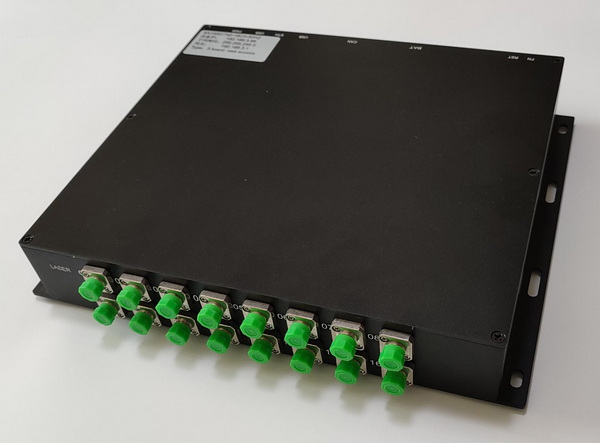
Below is an image of the OFSCN® Fiber Bragg Grating Interrogator:
1 Like