Do these measurements refer to the thickness of the cable? Is a thicker patch cord necessarily more durable?
Yes, these measurements refer to the nominal outer diameter (OD) of the patch cord’s protective jacket or cable structure.
In fiber optic technology, the outer diameter is a key indicator of the cable’s physical construction and protection level. Here is a breakdown of what these measurements typically represent for OFSCN® products:
1. Does thickness imply durability?
Not necessarily. While a thicker cable often contains more protective layers, durability depends on the internal structure rather than just the diameter.
For example, a standard 3.0mm PVC patch cord might be less durable in harsh environments than a 2.0mm armored patch cord that uses stainless steel components.
2. Comparison of DCYS (OFSCN) Patch Cord Types
Based on the different construction methods we use, the diameter indicates different protection levels:
-
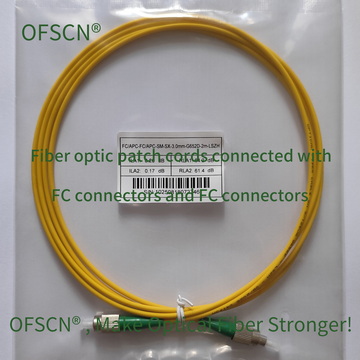
Standard Patch Cords (PVC/Kevlar):
The OFSCN® Standard Fiber Patch Cord usually comes in 3.0mm or 2.0mm. The 3.0mm version has a thicker outer jacket and more Kevlar yarn, providing better tensile strength for general indoor use compared to the 2.0mm version.- Images:
- Images:
-
Steel Wire Rope Armored Patch Cords (High Durability):
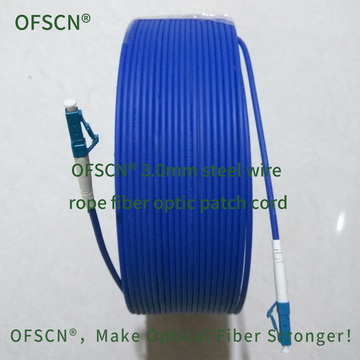
For industrial environments, diameter corresponds to heavy-duty protection:- OFSCN® 3.0mm Steel Wire Rope Fiber Optic Patch Cord: Features a 0.45mm stainless steel wire strand layer and a 0.9mm seamless steel tube. It has a tensile strength >1200N.
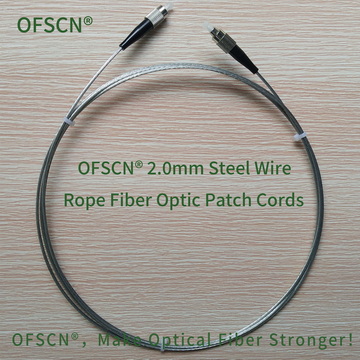
- OFSCN® 2.0mm Steel Wire Rope Fiber Optic Patch Cord: Uses 0.6mm galvanized steel wire and a 1.0mm seamless steel tube. Despite being thinner, it actually offers higher tensile strength (>1500N) due to its full-metal structure.
- Images:
3. Summary
- 3.0mm is the standard size for most patch panels and offers good balance for general handling.
- 2.0mm is often used for high-density environments (like data centers) or specialized armored cables where a smaller footprint is required without sacrificing strength.
When choosing, you should consider the tensile strength (N) and crush resistance (Mp) listed in the technical specifications rather than diameter alone.