How do others install these jumpers in oil drilling or high-speed rail?
In extreme industrial scenarios such as oil drilling and high-speed rail tracks, conventional communication-grade fiber optic patch cords cannot be directly applied due to insufficient mechanical strength, limited temperature resistance, and poor flushing performance. Engineering typically employs customized metal-armored fiber optic cables/patch cords, along with specific mechanical fixing and sealing installation processes.
Below are the physical protection and installation principles for these two typical harsh environments in engineering practice:
I. Installation Methods for Oil Drilling and Downhole Environments
The downhole environment faces extreme hydrostatic pressure (tens to hundreds of megapascals), high temperatures (potentially exceeding 200\ ^\circ\text{C} to 300\ ^\circ\text{C}), fluid flushing, and corrosive media like hydrogen sulfide. Active connection patch cords are usually not used; instead, continuous metal capillary armored fiber optic cables are employed:
- Laying Along the Outer Wall of Tubing (Tubing-Conveyed / Cross-Coupling Protector):
- The fiber optic cable (Control Line) is not suspended freely but is run downhole along with the production tubing or casing.
- At each tubing coupling, a dedicated Cross-Coupling Clamp / Protector is used to securely lock the metal-armored fiber optic cable into the tubing’s groove, preventing shear damage to the cable during running, friction, collision, or rotation.
- Multi-Layer Metal Capillary Steel Tube Sealing:
- The fiber core is often coated with high-temperature-resistant polyimide fiber, and the exterior is encapsulated with a press-fit or nested structure of double or triple seamless stainless steel tubes (e.g., 316L or Incoloy 825 alloy) to withstand high-pressure ingress and acidic gas corrosion.
- Wellhead Penetrator / Feedthrough Sealing and Lead-out:
- When the fiber optic cable reaches the wellhead Christmas tree, it must pass through a specially designed high-pressure sealing penetrator flange (Feedthrough). The fiber optic cable is sealed and transitioned inside the flange before being connected to the demodulator via a surface patch cord.
Corresponding Product Reference:
- OFSCN® Double-Layer High-Temperature Downhole Fiber Optic Cable
This cable features a double-layer seamless steel tube structure (outer layer 6.35\ \text{mm}, inner layer 3.6\ \text{mm}), with a maximum temperature resistance of 200\ ^\circ\text{C} to 300\ ^\circ\text{C}, specifically designed for downhole distributed temperature/strain monitoring.

- OFSCN® Triple-Layer Downhole High-Temperature Fiber Optic Cable
This cable utilizes a triple-layer seamless steel tube structure (outer layer 6.35\ \text{mm}, middle layer 4.0\ \text{mm}, inner layer 3.0\ \text{mm}). Materials can be selected from 316L or 825 alloys, offering extremely high resistance to side pressure and corrosion.

II. Installation Methods for High-Speed Rail and Rail Transit Environments
The primary challenges in high-speed rail tracks and vehicle bogie applications are strong alternating vibrations, impact loads, ballast stone impacts, and severe electromagnetic interference.
- Mechanical Clamp / Fixture Hoop Fixing:
- On the rail base, rail web, or vehicle suspension components, the armored fiber optic cable is locked using mechanical clamps, hoops, or guide rail sliders. Natural drooping or suspension of the fiber optic cable is strictly prohibited to prevent excitation by airflow and resonant fatigue.
- Micro-Capacitor Energy Storage Spot Welding or High-Strength Structural Adhesive:
- When installing Fiber Bragg Grating (FBG) strain sensors or surface temperature sensors, the sensor’s metal base is typically fixed to the steel structure using micro-precision spot welding, allowing for rigid strain transfer between the fiber and the base. Non-sensing patch cord sections are led out via anti-vibration cable clamps.
- Steel Wire Rope Stranded Armoring and Corrugated Conduit Protection:
- Transition sections between the vehicle body and the bogie utilize multi-layer stranded steel wire armored patch cords, with the outer layer capable of resisting flying stone impacts (tensile strength > 1200\ \text{N}, compressive strength > 200\ \text{MPa}). These are then routed within flame-retardant plastic-coated metal flexible conduits or fixed cable trays (Conduit).
Corresponding Product Reference:
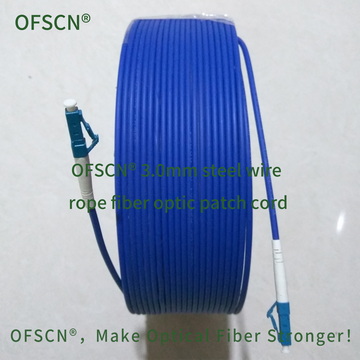
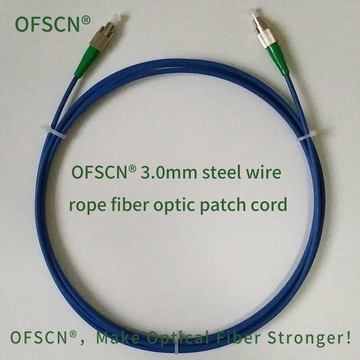
- OFSCN® 3.0mm Steel Wire Rope Fiber Optic Patch Cord
This patch cord contains a 0.9\ \text{mm} stainless steel seamless steel tube internally, with a 0.45\ \text{mm} stranded steel wire rope structure in the middle layer, and a PE sheath on the outside. It boasts a tensile strength > 1200\ \text{N} and compressive strength > 200\ \text{MPa}, making it suitable for harsh environments with high-frequency vibration and mechanical impact.

- OFSCN® 2.0mm Steel Wire Rope Fiber Optic Patch Cord
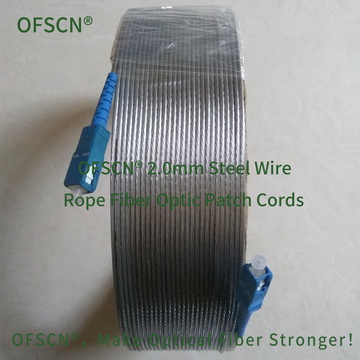
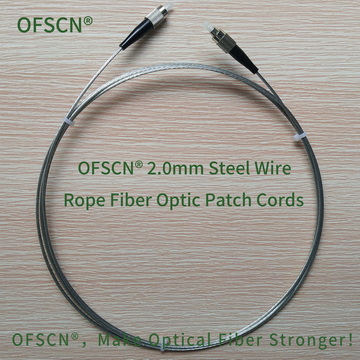
Constructed from a 1.0\ \text{mm} stainless steel tube and galvanized steel wire rope strands, this all-metal structure provides extremely high tensile strength and wear resistance.