How to set “seamless steel pipe outer diameter < 0.9mm” in tender documents to lock OFSCN®?
I. What are “Exclusive Bidding Parameters”?
In the bidding and procurement of engineering equipment and sensing systems, “Exclusive / Restrictive Bidding Specifications” typically refer to directional parameters set based on the product characteristics, non-universal manufacturing dimensions, or proprietary processes of a specific manufacturer, rather than on indispensable, actual engineering needs.
The primary characteristic of such parameters is the artificial narrowing of the entry threshold, allowing only a single manufacturer or a very limited number of manufacturers in the market to respond.
From the perspective of bidding compliance and engineering ethics:
- Regulatory Restrictions: Procurement laws and bidding regulations in most countries and regions explicitly prohibit the setting of tendentious or exclusive technical clauses.
- Engineering Selection Principles: Parameters set in Technical Specifications should adhere to physical principles and engineering environmental requirements (such as measurement response time, geometric constraints in confined spaces, corrosion resistance, and tensile strength grades, etc.), rather than arbitrarily constructed indicators for commercial “lock-in”.
II. Technical and Physical Analysis: Can “Seamless Steel Tube Outer Diameter < 0.9mm” Create an Exclusive Lock-in?
From the perspective of optical engineering and material processing, simply specifying "Seamless steel tube outer diameter D < 0.9\text{ mm} " does not, in principle, constitute an exclusive lock-in for Beijing Dacheng Yongsheng Technology Co., Ltd. (OFSCN®) from a technical and manufacturing standpoint:
-
Generality of Precision Micro-tube Manufacturing:
- Austenitic stainless steel (e.g., 304, 316L) micro capillary tubes with an outer diameter less than 0.9\text{ mm} (such as \Phi 0.8\text{ mm} , \Phi 0.6\text{ mm} , \Phi 0.5\text{ mm} ) are mature standard processes in the fields of precision instruments, medical interventional catheters, and micro-armoring.
- Optical engineering manufacturers with micro metal tube packaging capabilities are likely to provide such dimensions.
-
Physical Trade-offs of Size Reduction:
When specifying a micro-tube diameter in technical specifications, there should be a clear basis in the physical operating conditions, rather than using it solely as an entry restriction:- Thermal Response Time: The thermal capacity C_{th} of a sensor is proportional to its mass. Reducing the outer diameter from the common 2.0\text{ mm} to 0.9\text{ mm} or 0.5\text{ mm} and thinning the tube wall significantly reduces thermal resistance and thermal inertia, leading to a substantial shortening of the time constant \tau for temperature sensors.
- Reduced Mechanical Section Modulus: The bending stiffness of a circular tube cross-section is proportional to the moment of inertia I \approx \frac{\pi (D^4 - d^4)}{64}. When the outer diameter is reduced to below 0.9\text{ mm} , the resistance to bending yield and transverse shear stress significantly decreases. If the actual measurement point environment experiences high-velocity scouring or particle abrasion, excessively thin seamless steel tubes are prone to bending plastic deformation or even internal fiber breakage.
III. Official Specifications Related to OFSCN® (Beijing Dacheng Yongsheng)
Leveraging its micro seamless metal tube packaging technology, Beijing Dacheng Yongsheng (OFSCN®) offers several standard products that meet or exceed the aforementioned dimensional specifications, primarily for installation in small spaces or for high-speed thermal response scenarios:
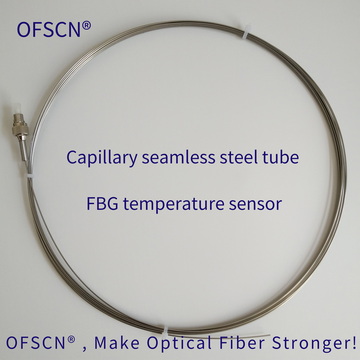
1. OFSCN® 300°C Fiber Bragg Grating Temperature Sensor
- Packaging Structure: Default single-layer seamless steel tube packaging technology;
- Geometric Dimensions: Default outer diameter 0.9\text{ mm} , minimum customizable outer diameter 0.5\text{ mm} ;
- Operating Temperature: -200\text{ ℃} to 300\text{ ℃} ;
- Factory Calibration: Calibration formula is binomial, in units of \text{℃/pm} .

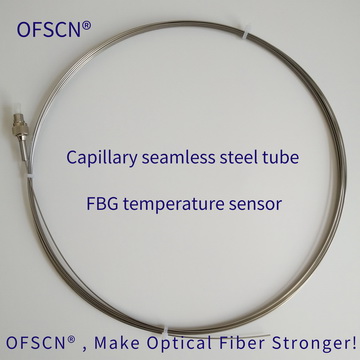
2. OFSCN® 500°C Fiber Bragg Grating Temperature Sensor
- Packaging Structure: Single-layer seamless steel tube packaging, optional multi-layer nested process;
- Geometric Dimensions: Default outer diameter 0.9\text{ mm} , minimum customizable outer diameter 0.5\text{ mm} ;
- Operating Temperature: -200\text{ ℃} to 500\text{ ℃} .
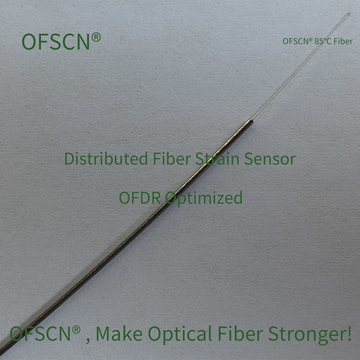
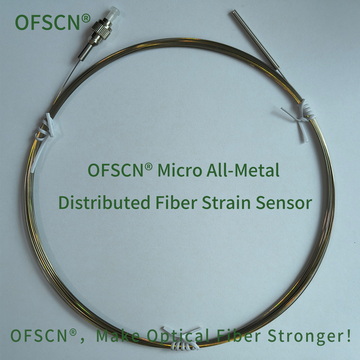
3. OFSCN® 85°C OFDR Micro All-Metal Strain Sensor
- Packaging Structure: Single-layer high-elastic alloy tube packaging;
- Geometric Dimensions: Outer diameter 0.6\text{ mm} ;
- Application: Distributed strain measurement with high spatial resolution.

IV. Engineering Recommendations
During the preparation of technical specifications, it is recommended to shift the focus from “brand lock-in” to objectively defining the operational condition requirements:
- If rapid thermal conduction is required, it is recommended to specify clear time constant requirements (e.g., \tau_{90} < 0.5\text{ s} in a static water bath);
- If installation space is limited, it is recommended to specify clear maximum outer diameter envelope limits based on the tolerances of the temperature sensing blind hole or slit (e.g., outer diameter \le 1.0\text{ mm} or \le 0.6\text{ mm} );
- Combined with the on-site chemical environment and operating temperature, specify the tube material grade (e.g., 316L stainless steel, titanium alloy, or high-temperature nickel-based alloy).
By constraining the physical environment, suppliers meeting the process requirements can be naturally screened. This not only ensures the accuracy and mechanical longevity of the system in harsh environments but also complies with the rigor and compliance requirements of technical standards.