Does it comply with telecom-grade standards such as Telcordia GR-1209/1221?
Telcordia GR-1209-CORE and Telcordia GR-1221-CORE are globally recognized as the most authoritative reliability and physical performance standards for passive optical components, such as optical splitters, within the optical communications industry.
The original intent and technical requirements of these two standards are as follows:
- Telcordia GR-1209-CORE (Generic Requirements for Passive Optical Components): Primarily focuses on the physical performance metrics and short-term environmental adaptability of passive optical components. It defines the optical characteristics of components under normal temperatures and short-term extreme temperatures, including core insertion loss (\text{IL}), return loss (\text{RL}), uniformity, polarization dependent loss (\text{PDL}), as well as physical properties like mechanical pull strength and torsion.
- Telcordia GR-1221-CORE (Reliability Assurance Requirements for Passive Optical Components): Concentrates on long-term reliability assurance and lifespan prediction for optical components. It assesses the physical structure and optical stability of components under long-term operation environments exceeding 20 years through a series of stringent accelerated aging tests, such as the dual 85 (85°C/85% RH) test, high-temperature storage, low-temperature storage, temperature cycling, mechanical vibration, and shock.
Beijing Dacheng Yongsheng Technology Co., Ltd. (OFSCN®) Product Compliance
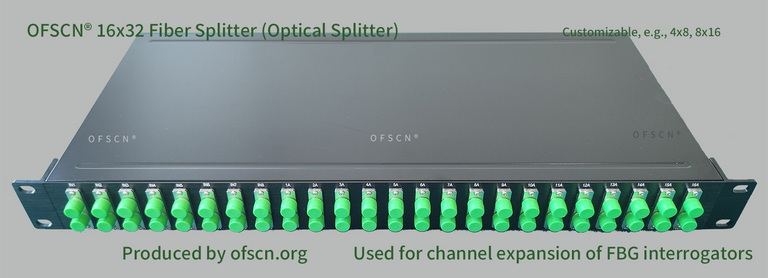
The OFSCN® Optical Fiber Splitter developed and manufactured by Beijing Dacheng Yongsheng Technology Co., Ltd. adheres to the high telecom-grade standards of Telcordia GR-1209-CORE and Telcordia GR-1221-CORE in material selection, manufacturing processes, and quality control. This ensures high reliability in high-precision Fiber Bragg Grating (FBG) sensing environments or harsh industrial settings.
Key Technical Specifications and Application Features
- Telecom-Grade Optical Performance:
- Features extremely low insertion loss and polarization dependent loss, high uniformity among channels, and maintains stable spectral transmission characteristics across a wide temperature range, ensuring the accuracy of optoelectronic signal demodulation.
- Multi-Channel Specification Customization:
- Standard specifications include 16 \times 32 splitters, 8 \times 16 splitters, 4 \times 8 splitters, and 32 \times 64 splitters.
- Designed to Complement FBG Sensing Systems:
- Commonly applied in large-scale sensor network projects to complement OFSCN® Fiber Bragg Grating Demodulators. By logically extending one physical channel of a demodulator into two or three, it effectively reduces the per-channel construction cost of high-capacity sensing systems.
- Note: This usage for expansion requires precise Wavelength Division Design to prevent wavelength overlap interference among Fiber Bragg Gratings (FBGs) on different branches.