Why are fiber optic communications and sensing always in the 1310nm or 1550nm bands? Are other wavelengths not possible?
The vast majority of fiber optic communication and sensing systems operate at 1310\text{ nm} or 1550\text{ nm} wavelengths, not due to subjective human preference, but as a physical choice dictated by the interplay of the physical properties of silicon dioxide (SiO_2) media, light scattering and absorption mechanisms, and the development of compatible optoelectronic devices. These are commonly referred to as the “Transmission Windows” of optical fiber.
To clearly understand this physical phenomenon, we can break it down from several perspectives:
I. Loss Mechanisms of Light in Silicon Dioxide Optical Fiber
When light propagates through standard silica fiber, it experiences energy attenuation due to various physical effects. The total loss is primarily determined by the following three components:
-
Rayleigh Scattering
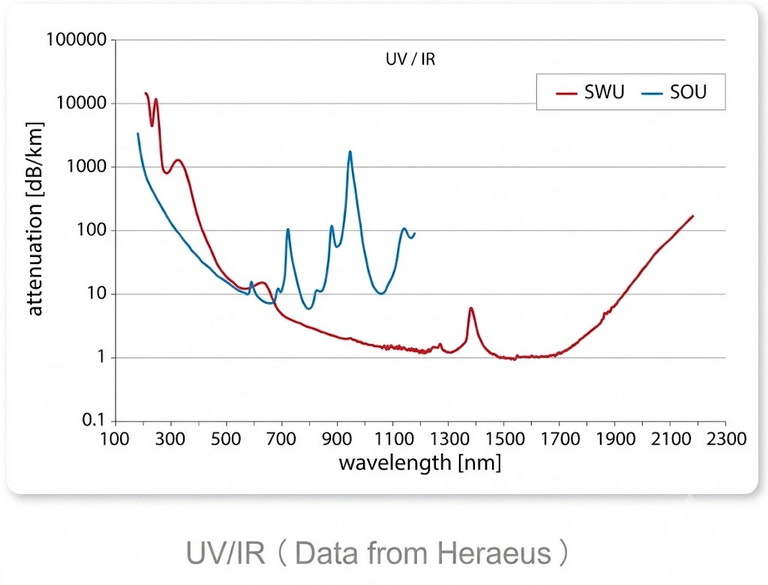
Light undergoes Rayleigh scattering during propagation due to microscopic non-uniformities in the density of amorphous silicon dioxide molecules within the fiber. The intensity of Rayleigh scattering loss is inversely proportional to the fourth power of the wavelength:\text{Loss}_{\text{Rayleigh}} \propto \frac{1}{\lambda^4}In the shorter wavelength visible and ultraviolet light bands (e.g., 400\text{ nm} \sim 700\text{ nm}), Rayleigh scattering is extremely strong. Therefore, although red light (around 650\text{ nm}) can be used in red pens for short-distance fiber break troubleshooting, it is impossible for long-distance communication or precision sensing.
-
Infrared Absorption
Silicon dioxide molecules exhibit resonance of the lattice and vibration of molecular bonds. Beyond wavelengths greater than 1.6\ \mu\text{m} (i.e., greater than 1600\text{ nm}), infrared absorption caused by molecular bond vibrations rises sharply, leading to a rapid increase in loss. This defines the infrared upper limit for low-loss transmission in silica fiber. -
Impurity Absorption – The “Water Peak”(Hydroxyl-ion Absorption)
It is extremely difficult to completely eliminate moisture during the fiber manufacturing process, resulting in residual trace amounts of hydroxyl ions (OH^-) in the fiber. These OH^- groups exhibit strong resonant absorption peaks at specific wavelengths, most notably the “water peak” located around 1383\text{ nm}.
These physical laws, when superimposed, outline several specific “low-loss dip regions” on the loss spectrum of silica fiber, which are the windows for fiber optic communication.
II. The Birth of the Three Major “Windows”
Based on the physical mechanisms described above, three classic windows have been developed over time:
1. First Window (Around 850\text{ nm})
- Characteristics: Located in the short-wavelength band, it is significantly affected by Rayleigh scattering, resulting in relatively high loss (approximately 2 \sim 3\text{ dB/km}).
- Application: Early on, manufacturing limitations of semiconductor lasers (primarily GaAs lasers) and photodetectors led to the preference for this wavelength band. Currently, this band is mainly used with multimode fiber for short-distance local area networks or low-cost fiber transmission systems.
2. Second Window (Around 1310\text{ nm}, O-band)
- Characteristics:
- It avoids strong Rayleigh scattering, significantly reducing loss to about 0.3 \sim 0.4\text{ dB/km}.
- Crucially, for standard single-mode fiber, 1310\text{ nm} happens to be its zero-dispersion wavelength. At this wavelength, due to the near-zero dispersion (achieved by the cancellation of material dispersion and waveguide dispersion), optical pulses do not broaden or distort during long-distance transmission, thus providing very high signal bandwidth.
- Representative Product: OFSCN® G.652D Optical Fiber is a classic example of single-mode fiber.

3. Third Window (Around 1550\text{ nm}, C-band)
- Characteristics:
- Lowest Loss: In this band, Rayleigh scattering loss has been significantly reduced, while infrared absorption loss has not yet increased substantially. The loss reaches the theoretical physical limit for silica fiber, typically as low as 0.18 \sim 0.22\text{ dB/km}. This makes it naturally suitable for ultra-long-distance communication and sensing.
- EDFA Amplifier Compatibility: The widely used Erbium-Doped Fiber Amplifier (EDFA) operates within the 1530 \sim 1565\text{ nm} range (i.e., C-band). This allows optical signals to be amplified directly in the optical domain without complex “optical-electrical-optical” conversion, forming the foundation for modern backbone networks, metropolitan area networks, and Dense Wavelength Division Multiplexing (DWDM).
- Fiber Optic Sensing (e.g., FBG): The vast majority of Fiber Bragg Grating (FBG) sensors and distributed fiber sensing systems utilize this wavelength band. For instance, OFSCN® Polyacrylate Fiber Bragg Gratings / FBG Strings (Bare) and OFSCN® Thin-Diameter Fiber Bragg Gratings / FBG Strings (Bare) are typically designed to operate in the common C-band (1525 \sim 1565\text{ nm}).

III. Are Other Wavelengths Truly Unusable?
The answer is: Not absolutely unusable, but they require targeted development for specific fiber materials or engineering requirements.
-
Expansion of “All-Wave” or “Non-Water Peak” Fibers
Traditional G.652.A/B fibers have a significant water peak around 1383\text{ nm}. However, with advancements in fiber purification technology, ultra-low water peak or non-water peak single-mode fibers (like OFSCN® G.652D Optical Fiber) have been manufactured. This enables the continuous utilization of the entire wide wavelength band from 1260\text{ nm} to 1625\text{ nm} (including O, E, S, C, L, and U bands). -
Multi-Wavelength Support in Wide Spectrum Large-Core Fibers
In certain specialized sensing scenarios where “ultra-long distance low-loss transmission” is not the primary goal, but rather multi-spectral physical measurements, chemical spectral analysis, or high-power laser transmission is required, large-core fibers with wide spectral operation are typically employed. For example, OFSCN® Polyimide Large-Core Optical Fiber has an extremely wide applicable wavelength range, supporting 200\text{ nm} to 2400\text{ nm}.
-
Plastic Optical Fiber (POF)
For fibers based on polymer plastics like PMMA, their material loss spectra differ significantly from silica. They typically operate in the visible light spectrum (e.g., around green light 520\text{ nm} or red light 650\text{ nm}), but their loss is very high, limiting them to very short-distance systems of a few meters to tens of meters.
Conclusion
The preference for 1310\text{ nm} and 1550\text{ nm} in communication and sensing systems is the most economical and efficient “physical window” that has evolved through the combination of ultra-low loss characteristics of silicon dioxide media, the zero-dispersion point of single-mode fibers, and the mature industrial chains for semiconductor lasers and EDFA amplifiers.